11011101
Odu #222 · Meji (Odu Puro)
Irete Meji
Irete Meyi (lucumí)
"In the Tratado, the one who went down to the land of the dead and returned to the living (p. 1404)."
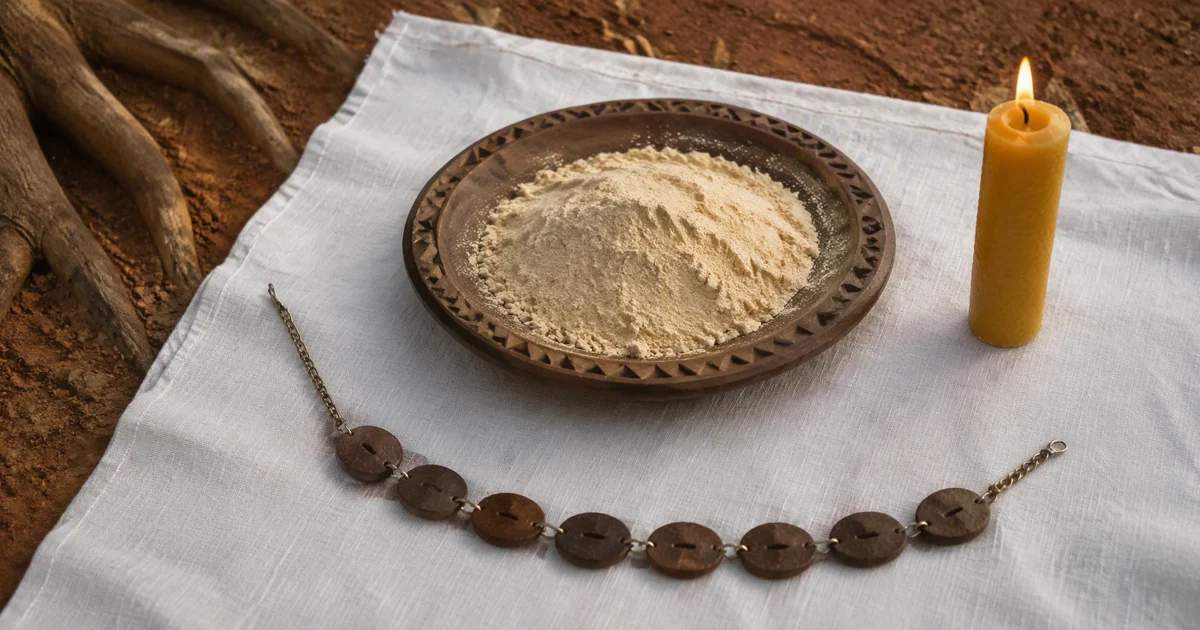
Numerology
14 (purification, renewal, clarity after the storm)
Elements
Wind - Storm | Lightning - Revelation | Rain - Purification
Sacred Colors
Storm blue (transformation), Grey (clarity), Vibrant green (renewal after rain)
Also known as: Ate Meji · Ìrẹtẹ̀ Meji · Irete Meyi
Naming by tradition
- Yoruba / Brazil
- Irete Meji
- Cuba (Lucumí)
- Irete Meyi
Lucumí name per Tratado Enciclopédico de Ifá, p. 1387.
What is the Odu Irete Meji
In the Tratado (p. 1403), Irete Meji (Eji Ede, Irete Meyi, Eji Elemere) is the magma of the earth, a female Odu, a sign of the earth that rules over everything that is death. It is charged with raising the dead, which is why it is called Oye Emere: it laughs at death, and Iku can do nothing (p. 1403). Born in this sign are the spirit of Oduduwa called Elesemefa, strength in the hands and teeth, and the astral bodies (p. 1402). It is a strong Odu that marks long life (p. 1403).
Meaning
The Tratado tells that Eji Elemere, while hunting a deer for the ẹbọ that would give him a son, fell into a pit and was pulled out by Kporoye; the son of that encounter, Olomo, was later bought as a slave for the human sacrifice at his own father’s festival, and the executioner, under Eshu’s influence, blunted the knife (pp. 1390–1396). Once the son was recognized, Eji Elemere proclaimed that Orunmila would no longer offer a human being to Ifa, the end of human sacrifice in Ifa practice (p. 1396). The Tratado records that, in ire, it is an Ifa of riches, but of setbacks and traps, and, in osogbo, of scarcity (p. 1404).
Sacred Profile
Numerology: 14 (purification, renewal, clarity after the storm). This number resonates in the energy of this Odu, guiding the seeker in understanding the cycles and vibrations that govern this path.
Elements: Wind - Storm | Lightning - Revelation | Rain - Purification. The sacred elements establish the bridge between the material and spiritual worlds, offering tools of balance and transformation.
Sacred Colors: Storm blue (transformation), Grey (clarity), Vibrant green (renewal after rain). The colors of this Odu carry specific vibrations that can be used in rituals, clothing, and environments to harmonize with its energy.
Qualities: Purification, Revelation, Resilience, Renewal, Clarity. These qualities represent the inner forces that the seeker can cultivate to walk in alignment with the wisdom of this Odu.
✦ Recommendations
In the Tratado (p. 1387), when this Odu comes out, ẹbọ is prescribed with worn clothing, preferably black, as the dove and the husk of the palm fruit did, and they were saved. The Tratado prescribes asking whether the person is building a house and, if so, halting the work for a while (p. 1388). It records that the awo must be courageous and make ẹbọ to drive the araye away (p. 1403), and it prescribes great respect for Ogun and Yalorde (Oshun) (p. 1406) and learning the suyeres of Orunmila (p. 1405).
⚠ Cautions
In the Tratado (p. 1403), the prohibitions of this sign include using indigo, eating ekru, adalu, etu, eko, corn stew, banana, and killing ants. The owner of this Ifa may not hang up their clothes, because it holds them back, and holes may be neither dug nor crossed (p. 1405). Cracking palm kernels is forbidden in a house where an Ifa initiation is being held during the seven days (p. 1393). The Tratado warns against the servant who tries to betray or lie (p. 1400), speaks of many enemies (p. 1406), and records that this sign speaks of illness in the legs (p. 1405).
This Odu describes tendencies and possible paths to work on — not a fixed destiny or a guaranteed prediction.
Ire
Riches (p. 1404), long life (p. 1403), good omens and journeys that reach their end without incident and with love (pp. 1403–1404), victory over death, as in Orunmila’s fight with Iku (pp. 1411–1412), and prosperity (p. 1389).
Osogbo
Scarcity (p. 1404), setbacks and traps (p. 1404), many enemies (p. 1406), the servant who betrays (p. 1400), the ingratitude of those who were helped (p. 1399), and the wounded pride the Tratado attributes to the children of this Ifa (p. 1404).
Ese Ifá
«Ẹni tí kò sá fún iṣẹ́ á jẹ ẹrù iṣẹ́» — Who does not flee from work reaps its fruits.
Itan
Irete was the Odu that saw the world take long to change and did not tire. Waited. And when the world finally changed, it was he who received the crown.
Prayer
Irete Meji, give me firmness in my knees and calm in my heart. May I not give up one step before arrival.
Context and study of the 256 Odus
Irete Meji belongs to the full corpus of the 256 Odus of Ifá, a body of oral and written wisdom spanning centuries across the African diaspora and the Americas. Understanding this Odu means placing energies, archetypes, and sacred narratives in relation to the opele, divination, and a life practice guided by balance. The philosophical reading offered on this page does not replace initiation with a Babalawo or Iyanifa, but it deepens respect for the tradition and supports structured study for those who learn with humility.
In Ifá texts, the name Irete Meji appears in prayers, ebo, and songs; its energy is tied to cycles of transformation and to relationship with the land, the Orishas, and community. Comparing this Odu with its root Meji and related Odus helps you recognize patterns of Irê and Osogbo that recur through life and everyday choices.
The Ifá Wisdom digital library brings together all 256 paths with epithets, essence, synthesis, and practical guidance. By exploring this page and the full library, you build a foundation for meditation, spiritual journaling, and ethical follow-up—with explicit gratitude to Yoruba culture and its guardians.
Start with the basics: What is Ifá? Orunmila, the 256 Odus and the babalawo →
Irê, Osogbo, and reading Irete Meji
In any Odu, Irê points to blessings and positive affinities; Osogbo highlights challenges and adjustments. Reading this Odu invites integrated reflection on relationships, work, emotional health, and purpose. Ifá asks for patience, right speech, and—when prescribed by an initiated priest—ebo and disciplines of conduct.
The study tool on this platform uses artificial intelligence to offer a philosophical and educational reading of the Odus: a bridge for learning, not divination or a priestly ritual. Keep that distinction to honour the tradition and the role of Babalawos and Iyanifas.
Ethics, respect, and continuing study
Ifá Wisdom is a multilingual educational service. We combine careful documentation of the Odus with the awareness that the living tradition of Ifá belongs to the communities that preserve it. We do not promise cures, material guarantees, or a substitute for initiatory counsel.
To study Irete Meji in depth, browse the library of 256 Odus, the Odu of the day and, if you wish, a contextual AI study reading — always respecting your autonomy and the culture of origin.
Orishas linked to this Odu
The Orishas named in the titles of this Odu’s patakís in the Tratado Enciclopédico de Ifá, with the patakí number and the page. The title is given as printed, in Spanish. The link says where the Orisha appears in the text; it says nothing about rulership or worship.
Frequently asked questions
What does the Odu Irete Meji mean?+
What is the central message of Irete Meji?+
What is Irete Meji called in the Lucumí (Cuban) tradition?+
What are the Irê and Osogbo of Irete Meji?+
What is the figure (mark) of Irete Meji?+
Sources consulted
- Sixteen Great Poems of Ifá — Wándé Abímbọ́lá, p. 29
- Ifa Divination — William Bascom, caps. III–IV
- Tratado Enciclopédico de Ifá, section Irete Meyi (Eji Ede), pp. 1387–1414
Written by
- Pablo de Lima (Awofakan)
- Thaiana de Lima (Ikofá)
A couple initiated in Ifá in the Cuban lineage — Regla de Ocha / Ifá.
Meet the authors →Notice: This platform is an educational and cultural tool. The readings are study and contemplation material on the corpus of the 256 Odus — not an Ifá divination session. They do not replace professional medical, psychological, legal or financial advice, nor a consultation with an initiated priest.