Logun Ede: Hunter and Fisher Orisha, Son of Oshun

Loci Loci, Logun Ede! Among all the Orishas, there is one always described as young — not merely young in age, but young in spirit: joyful, vain, playful, of a beauty the itans never tire of praising. He is Logun Ede, the prince of the Yoruba pantheon, son of two of the most beloved deities: Oshun, lady of the fresh waters, and Oshosi, the hunter of the forest.
From one he inherited the mirror and the sweetness of the waters. From the other, the bow and the unerring aim. And, unable to choose between the two worlds that formed him, Logun Ede did something no other Orisha does: he decided to live in both.
Who Is Logun Ede? Meaning and Origin
Logunedé (in Yoruba: Lògunẹdẹ, also written Logun Ede) is the young Orisha of hunting and fishing, lord of the abundance that comes from both river and forest. The meaning of his name is tied to the town of Ede, in the Ijesha region of southwestern Nigeria — Logun of Ede, the lord of Ede. This is why Logunedé is especially revered in the Ijexá nation of Candomblé.
In the Nigerian and Cuban traditions, his father is Erinle (or Inle), the hunter and healer deity of the waters. In Brazil, Erinle was assimilated into the figure of Oshosi, and it is as the son of Oshun and Oshosi that Logun Ede is known in Brazilian terreiros.
He is, above all, the Orisha of youth: he represents that phase of life when one does not yet have to choose a single path, when one can be many things at once, when joy and curiosity have not yet been tamed by the harshness of the world.
The Myth of the Six Months: Between River and Forest
Logun Ede's best-known itan is also the most beautiful:
When Logun Ede was born, child of Oshun and Oshosi, both parents wanted to raise him each in their own way. Oshun wanted the boy in the waters of the river, among the fish, the gold and the mirrors. Oshosi wanted his son in the forest, learning to track, to wait in silence, to hit the mark.
Neither would yield. And the boy, who loved father and mother equally, did not know whom to choose — because choosing one would be betraying the other.
So an agreement was made. For six months of the year, Logun Ede would live in the river with Oshun, eating fish, learning beauty, vanity, sweetness and the secrets of the waters. For the other six months, he would live in the forest with Oshosi, eating game, learning patience, aim, courage and the secrets of the woods.
And that is how Logun Ede became the only Orisha who masters two worlds entirely — not by halves, but twice whole.
This is the form most often told in Brazil. The compilations record the origin in more than one way, worth knowing: Reginaldo Prandi collects two versions. In one, Oxum and Oxóssi are a vain couple who live at odds, separate, and so split their son's time between the river and the forest — and when Obá tries to drown the boy in the river, it is Orunmilá who saves him and gives him the task of protecting those who live from the fresh waters. In the other, Oxum falls for the hunter Erinlé, who is drawn only to women of the forest; she covers her body in honey and disguises herself as a forest woman to deceive him, but the river waters wash the honey away, Erinlé discovers the deception and abandons her, and Logunedé is born of that undone union. In all of them the core is the same: he inherits the ofá (bow) from the hunter father and the abebé (mirror) from the mother of the waters, and lives whole in both worlds. (Prandi, "Mitologia dos Orixás", myths "Logum Edé é salvo das águas" and "Logum Edé nasce de Oxum e Erinlé".)
The lesson of this myth is subtle and powerful: Logun Ede is not a middle ground. He is not half hunter and half fisher. He is a complete hunter and a complete fisher — because he devoted full time to each apprenticeship, in its proper season.
Sacred Attributes
- Colors: turquoise blue (or light blue) and gold — the waters of the father and the gold of the mother
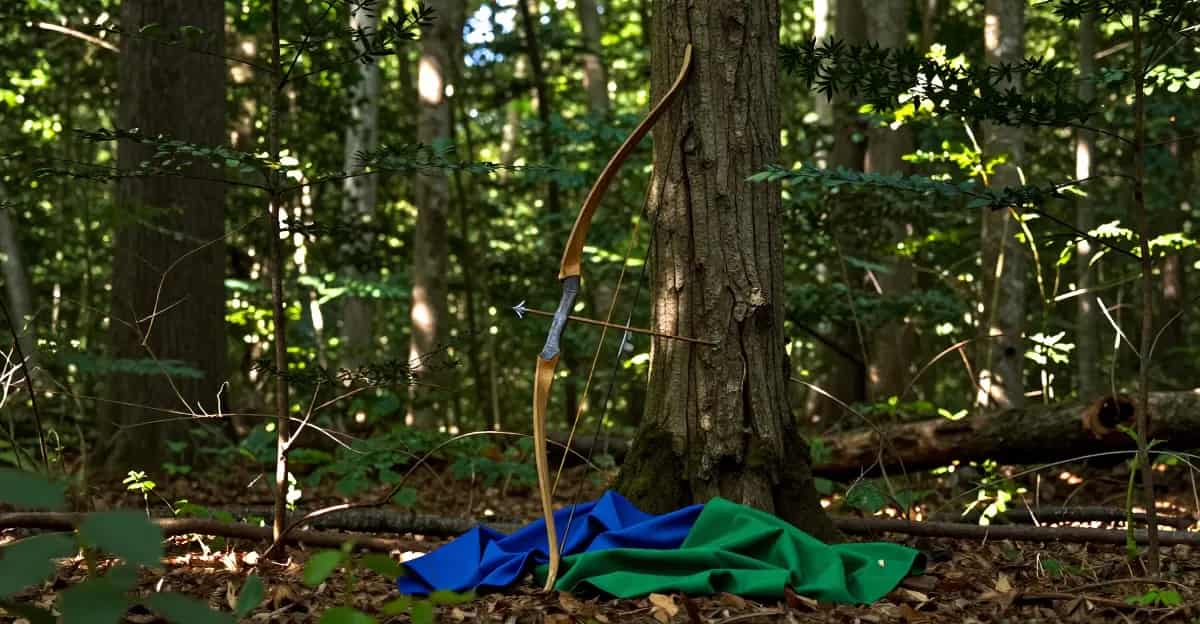
- Symbols: the ofá (bow and arrow), inherited from Oshosi, and the abebé (golden mirror-fan), inherited from Oshun. Logun Ede is the only Orisha who carries both
- Domain: rivers, the forest, abundance, youth, beauty
- Votive foods: omolocum (black-eyed peas with eggs, Oshun's food) and axoxô (red corn with coconut, Oshosi's food) — he eats from both parents
(This box is the Afro-Brazilian cult, where Logun Ede is the son of Oshun and Oshosi. In Nigeria and Cuba, son of Oshun and Erinle/Inle, the worship and offerings are different — see the section just below.)
- Day of the week: Thursday in many houses (varies by tradition)
- Elements: the exact point where river meets forest
- Greeting: Loci Loci!
Notice the beauty of the symbolism: Logun Ede is the only one who carries bow and mirror at once. The bow points outward — action, hunting, conquest. The mirror points inward — contemplation, self-knowledge, beauty. Few images in the Yoruba tradition say so much about human balance.
Is Logun Ede Male or Female?
This is perhaps the most common question about this Orisha — and it deserves an honest answer.
In the tradition, Logun Ede is male. He is the young prince, the boy hunter and fisher. His fame for beauty and delicacy, combined with the myth of the six months, gave rise in Brazil to a popular reading that he would be "six months a man, six months a woman".
That reading, though widespread, conflates two different myths:
- Logun Ede's six months are about habitat — river with his mother, forest with his father. There is no gender change in the itan.
- The one who does alternate between masculine and feminine through the year, in the tradition, is Osumare, the Orisha of the rainbow.
That said, it is fair to recognize that in Brazil Logun Ede has become a figure beloved by many LGBTQIA+ people within African-matrix religions — precisely because he is the Orisha who refuses to choose between two worlds, who carries the masculine and the feminine of his parents without denying either. This diasporic reading has real affective value for those who live it, and it need not be confused with the traditional itan in order to be respected.
Perhaps the deepest truth of Logun Ede is this: he teaches that belonging to two worlds is not being split in half — it is being twice whole.
Logun Ede in Nigeria, Cuba and Brazil
In Nigeria, his cult is concentrated in the Ijesha region, especially in the towns of Ede and Ilesa. There, Logun Ede is revered alongside Erinle, and both are linked to the waters and to hunting.
In Cuba, in Santería, he appears as Logun Ede (or Laro), son of Ochún and Inle, an orisha of more restricted worship, frequently received together with Inle. He is associated with Saint Michael the Archangel or Saint Expeditus, depending on the lineage.
In Brazil, he is especially worshipped in Ketu and Ijexá Candomblé. The syncretism varies by region: in some houses he is associated with Saint Expeditus, in others with Saint Michael the Archangel or Saint Anthony — all young, all linked to the idea of swift help and urgent causes. His children-of-saint are known for beauty, joy, a certain charming vanity, and the versatility of those who move well through very different environments.
How to Honor Logun Ede
- Don't force yourself to choose too early. Logun Ede is the Orisha of those still discovering. If you are living a phase of doubt between paths, he teaches that exploring both is legitimate — and that time will tell.
- Devote yourself fully, one thing at a time. Logun Ede's secret is not doing everything at once; it is giving each apprenticeship its complete season. It is the opposite of scattering.
- Honor both inheritances. We all carry traits of those who raised us. Recognizing what came from the mother and what came from the father — without denying either side — is living Logun Ede's energy.
- Cultivate joy. He is the young, festive Orisha who laughs. Allowing yourself lightness is not a lack of seriousness: it is honoring the youth that still lives in you.
- Visit where waters meet the woods. A river inside a forest is Logun Ede's exact territory. Being there, in silence, is a simple way to connect with him.
Logun Ede was not made to choose between the water and the woods — and the lesson he leaves is that he would not have to: six months learning to fish, six months learning to hunt, he was never half of anything. Whoever called him divided missed the point; he is twice whole.
Loci Loci, Logun Ede! May the young prince of river and forest bring you the joy of those still discovering, the courage to honor all your inheritances, and the wisdom to know that you need not be only one thing to be whole.
What you have read here is rooted in the 256 Odus of Ifá — the corpus we study verse by verse. Read them as contemplation: real divination belongs at the table of a consecrated babalawo.
Sources consulted
- Mitologia dos Orixás — Reginaldo Prandi
Written by
- Pablo de Lima (Awofakan)
- Thaiana de Lima (Ikofá)
A couple initiated in Ifá in the Cuban lineage — Regla de Ocha / Ifá.
Meet the authors →Last reviewed:
Get the wisdom in your inbox
One new article a week on Orishas, Odus and Yoruba philosophy. No spam.
Unsubscribe anytime, one click from any email.
Comments
Loading comments...
You need to sign in to comment.