Nana Buruku: The Oldest Orisha, Lady of Primordial Clay
Saluba, Nana Buruku! Nana Buruku is the oldest of all Orishas. She was worshipped before the others were born, before humanity existed, before iron was discovered. Nana Buruku is the primordial clay — the raw material from which Oxalá molded human beings. If Oxalá is the sculptor, Nana Buruku is the clay. Without her, there is no creation. Without her, there is no life.
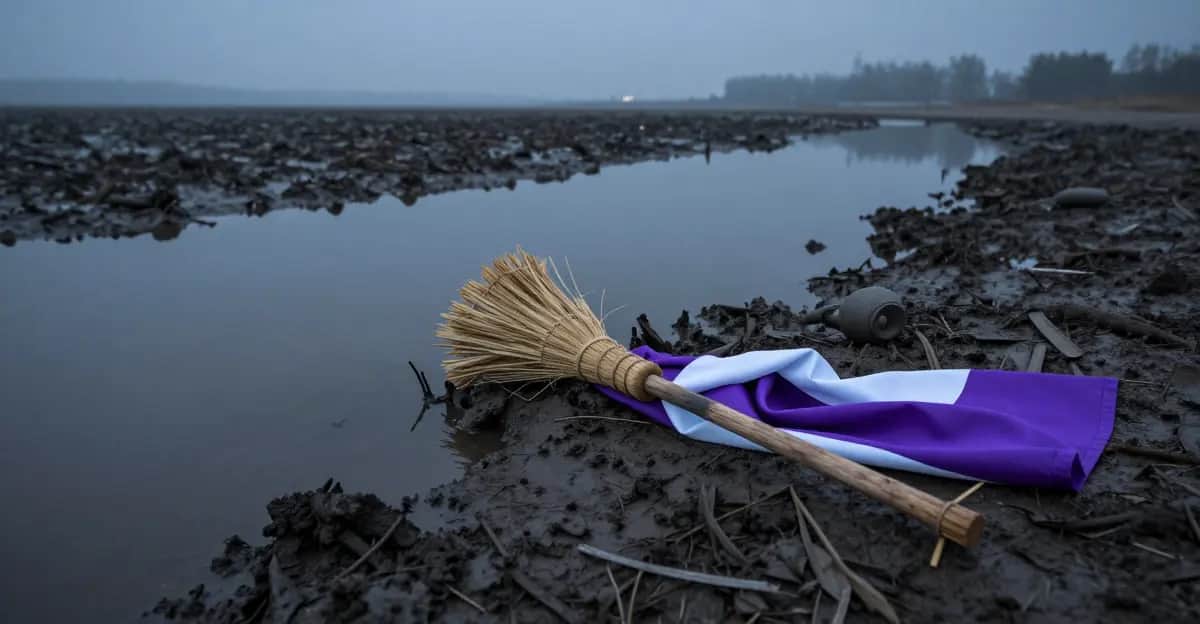
Nana Buruku is not a deity of explosions or storms. She is the Orisha of wisdom that comes with time, of serenity in the face of death, of the cycle that completes itself. While other Orishas govern rivers, winds, fire, and thunder, Nana Buruku governs something older and deeper: the mud at the bottom of the swamp — that dark, moist, and fertile place from which all life emerges and to which all life returns.
Who Is Nana Buruku
Nana Buruku (in Yoruba: Nàná Bùrúkú) is a pre-Yoruba deity. Some scholars believe her cult is older than that of the Orishas themselves — belonging to a layer of African religiosity that predates the organization of the Yoruba pantheon as we know it. The suffix Buruku can mean "great, powerful" or "fearsome," depending on linguistic interpretation.
In Yoruba cosmology, Nana Buruku occupies a unique place: she is simultaneously a chthonic deity (linked to earth, to the underground, to what lies below) and an ancestral deity (linked to those who came before, to the ancestors, to memory). She is the cosmic grandmother — the matriarch who existed when the world was nothing but clay and water.
Nana Buruku is mother of two fundamental Orishas: Obaluaye (the lord of earth, disease, and healing) and Osumare (the rainbow, the serpent that connects sky to earth). This family — Nana Buruku, Obaluaye, and Osumare — forms the so-called terrestrial triptych, three divinities linked to the earth, to the cycle of life-death-rebirth, and to the mysteries of what lies beneath the surface.
Sacred Attributes
Everything about Nana Buruku speaks of depth, antiquity, purple, and clay:
- Colors: purple, lilac, and white (in some houses, dark blue)
- Symbols: the ibiri (curved staff made from palm leaf rib, decorated with cowrie shells and beads — represents the maternal womb and the cycle of life), the swamp, the clay
- Day of the week: Saturday (in many traditions)
- Main votive food: aberém — a cake of white corn cooked and wrapped in banana leaf, simple and ancient like Nana Buruku herself
- Elements: clay, swamp, moist earth, fine rain
- Greeting: Saluba, Nana Buruku! (exclamation of reverence to the ancestral grandmother)
A fundamental particularity of Nana Buruku: she does not accept metal. No knife, no needle, no iron instrument may be used in her rituals. This prohibition is linked to the mythical conflict between Nana Buruku and Ogun — and it is one of the most important stories in the Yoruba pantheon.
The Creation Myth: Nana Buruku's Clay
Nana Buruku's most important story is the myth of human creation:
In the beginning, Olódùmarè charged Oxalá with creating human beings. Oxalá had the skill, patience, and wisdom to model forms — but he lacked the raw material. He tried air, water, fire, stone — nothing worked. The bodies crumbled, melted, evaporated.
It was then that Nana Buruku offered what no one else had: the clay from the bottom of her swamps — ancient, fertile, moist, malleable matter. With this clay, Oxalá finally managed to mold human bodies. And Olódùmarè blew the èmí (vital breath) into each one, giving them life.
But Nana Buruku imposed a condition: "If the clay is mine, everything made from it shall return to me." Since then, when a human being dies, their body returns to the earth — to Nana Buruku's clay. The spirit ascends to the Orun, but the body returns to the primordial swamp.
This myth is profoundly philosophical: it teaches that we are born from the earth and to the earth we return. Death is not an end — it is a return. And Nana Buruku is not a sinister deity for being linked to death: she is the serene grandmother who receives her grandchildren back to her lap when the earthly journey ends.
The Conflict with Ogun: The Refusal of Metal
One of the most dramatic stories in the Yoruba pantheon is the conflict between Nana Buruku and Ogun:
When Ogun invented iron and forged his tools — the sword, the machete, the knife, the hoe — he demanded that all the Orishas acknowledge the superiority of his invention. "Without my iron," said Ogun, "nothing can be cut, hunted, prepared, or built. Everyone depends on me."
Nana Buruku, the oldest of all, stood up and replied: "I existed before you. I existed before iron. My children were born without your tools, my rituals need not your metal, and the dead I receive carry nothing of iron with them."
And to prove her point, Nana Buruku declared she would never again use iron in her rituals. Instead of metal knives, she would use bamboo knives. Instead of needles, she would use thorns. Her followers, to this day, uphold this prohibition — in Nana Buruku's temples, metal is strictly forbidden, and the blades are sharpened bamboo or shell.
This conflict is more than a quarrel between two Orishas: it is a civilizational metaphor. Ogun represents technology, progress, modernity. Nana Buruku represents tradition, nature, the ancestral. The message is that not everything new is necessary, and not everything old is obsolete. There is wisdom in resisting novelty when it comes with arrogance.
Nana Buruku and Death: The Serene Grandmother
In Yoruba tradition, the relationship with death is radically different from the Western tradition. Death is not an enemy to be defeated — it is a transition, a passage from the Ayé (physical world) to the Orun (spiritual world). And Nana Buruku is the guardian of that passage.
While Oya conducts the Eguns (spirits) with the force of wind and fire, Nana Buruku receives the bodies with the serenity of clay. It is she who reabsorbs the matter — the clay returns to clay, the earth returns to earth. There is no violence in this process: there is return.
For this reason, Nana Buruku is frequently invoked in funeral rituals — especially in the axexê (funeral rituals of Candomblé), where the body is prepared to return to the earth and the spirit is guided to the Orun. Nana Buruku's presence in these rituals is a promise that death is welcome, not abandonment.
Nana Buruku in Nigeria and Benin
The cult of Nana Buruku has deep roots in the region of the ancient Dahomey (present-day Benin), where she was known as Nana Buluku — an androgynous creator deity, simultaneously masculine and feminine, who gave birth to the twins Mawu (moon, feminine) and Lisa (sun, masculine). In this Fon/Ewe tradition, Nana Buluku is the supreme deity — above even Mawu-Lisa.
In Yoruba Nigeria, Nana Buruku's cult is more localized but equally profound. Her sanctuaries are typically in swampy areas, near still-water rivers or lagoons — places where the clay is thick and fertile. Nana Buruku's priestesses are almost always elderly women, respected by the community as guardians of ancestral memory.
Nana Buruku in Cuba: The Silent Presence
In Cuban Santería, Nana Buruku is a rare but present deity. She is known as Naná Burukú and syncretized with Saint Anne (grandmother of Jesus). Our Lady of Mount Carmel is sometimes attributed to her, but in Cuba the Virgen del Carmen leans towards Oya — the Carmelite tie is to the souls in purgatory, and those are her ground. The association with Saint Anne is particularly beautiful: both are grandmother figures, both carry the wisdom of age, both are revered not for what they do, but for what they represent — the root, the origin, the beginning of everything.
Nanã in Brazil: Purple, Swamp, and Silence
In Brazil, Nanã is one of the most respected Orishas, although her cult is more discreet than that of popular Orishas like Iemanjá or Xangô. Temples dedicated to Nanã are often the oldest and most traditional — and her devotees are known for their serenity, patience, and a certain wise melancholy.
In Candomblé, Nanã's festivals are marked by the color purple, by reverent silence, and by the presence of much corn-based food. Nanã's devotees dance slowly, hunched over, as if carrying the weight of the world's age. The ibiri — her curved staff — sways gently from side to side, mimicking the movement of cradling a child.
In Umbanda, Nanã is frequently associated with the pretas-velhas — entities of elderly Black women, enslaved in life, who return to advise, heal, and console with the wisdom accumulated over centuries of suffering and resistance. The connection is natural: both Nanã and the pretas-velhas represent ancestral feminine wisdom — one that does not shout, does not shine, does not impose itself, but sustains everything in silence.
Nanã's syncretism in Brazil is with Saint Anne (mother of Mary and grandmother of Jesus). July 26th, Saint Anne's feast day, is celebrated in many houses as Nanã's day. In Salvador, some of the oldest Candomblé houses maintain specific rituals for Nanã on this date — always discreet, always at night, always with purple candles.
Nana Buruku, Obaluaye, and Osumare: The Family of Earth
The relationship between Nana Buruku and her children is one of the richest in the pantheon:
Obaluaye (also called Omolu) is the Orisha of disease and healing — covered in straw to hide the marks of smallpox. Tradition tells that Nana Buruku abandoned Obaluaye when he was born sick, casting him into the sea. It was Yemoja who rescued and raised him. Later, Nana Buruku reconciled with her son — but the scar remains. This story teaches that even the most ancient wisdom can err, and that repentance and reconciliation are part of the path.
Osumare is the Orisha of the rainbow — the serpent that connects sky to earth, that transports river water back to the clouds. Where Nana Buruku is depth and earth, Osumare is elevation and sky. Together, mother and child represent the complete cycle: from clay to rainbow, from ground to firmament.
How to Honor Nana Buruku
You don't need to be initiated to respect Nana Buruku. Here are universal ways:
- Respect the elderly. Nana Buruku is the cosmic grandmother. Honoring her is honoring all grandmothers, all elderly women, all guardians of memory. Sit down, listen, learn from those who have already lived.
- Take care of the earth. Plant something. Put your hands in the clay. Nana Buruku is in the moist garden soil, in the pot's clay, in the rain's mud. Getting your hands dirty in the earth is an act of connection with the oldest of Orishas.
- Light a purple candle on Saturdays. Ask for wisdom and patience. Nana Buruku doesn't give quick answers — she gives right answers. And right answers take time.
- Accept the cycles. Nana Buruku teaches that everything is born, grows, dies, and is reborn. If something in your life is ending, don't fight it. Let it return to the clay. Something new will be born from there.
- Wear purple. A silent way to honor Nana Buruku in daily life. Purple is the color of depth, contemplation, and connection with ancestors.
"Clay does not shine like gold, does not cut like iron, does not burn like fire. But without clay, none of them would exist. Nana Buruku is the beginning of everything — and the end of everything is to return to her."
Saluba, Nana Buruku! May the wisdom of the oldest Orisha guide your steps, may the primordial clay sustain your feet, and may the serenity of the cosmic grandmother give you the peace of knowing that everything that is born returns, and everything that returns is reborn.
What you have read here is rooted in the 256 Odus of Ifá — the corpus we study verse by verse. Read them as contemplation: real divination belongs at the table of a consecrated babalawo.
Sources consulted
- Mitologia dos Orixás — Reginaldo Prandi
- Orixás — Pierre Fatumbi Verger, pp. 81–86
Written by
- Pablo de Lima (Awofakan)
- Thaiana de Lima (Ikofá)
A couple initiated in Ifá in the Cuban lineage — Regla de Ocha / Ifá.
Meet the authors →Last reviewed:
Get the wisdom in your inbox
One new article a week on Orishas, Odus and Yoruba philosophy. No spam.
Unsubscribe anytime, one click from any email.
Comments
Loading comments...
You need to sign in to comment.