Yewa, the Orisha of Mystery: Hidden Beauty and Passage

One of the Yewa myths gathered by Reginaldo Prandi ends by admitting that nobody knows who the woman living in the cemetery is, where she came from, or why she is there: everything that happened is her secret (Prandi, myth "Euá é expulsa de casa e vai viver no cemitério"). Few Orishas carry mystery so openly: the myth itself warns that it will not tell everything.
Prandi spells the name Euá, and the glossary of his book gives the Yoruba form Yèwá in brackets. Here we use Yewa (in Brazilian Candomblé you will also find Ewá). The glossary defines her in a few words: Orisha of the springs and keeper of the cemeteries (Prandi, Glossary, entry "Euá"). A water that wells up, and a territory of the dead. This text reads eight myths from her chapter to see how those two things come together.
A caution about who she is
Before the myths, a difficulty the tradition itself does not settle. Pierre Verger records that in Bahia people say there are seven Yemojas, and one of them is Eua (Yewa), a river that in Africa runs alongside the Ògùn and that certain legends blend with Yemoja herself (Verger, Orixás, p. 69). In part of the tradition, then, Yewa appears as a face of Yemoja; in Prandi's myths she is an Orisha with her own name, family and fate. We will stay with the myths and leave the genealogical debate open.
The genealogy, in fact, changes from myth to myth. In two of them Yewa is a daughter of Nana Buruku (Prandi, myths "Euá transforma-se na névoa" and "Euá é escondida por seu irmão Oxumarê"), and in the first she appears as a sister of Obaluaye, Osumare and Osanyin; in two others she is a daughter of Obatala, who keeps her in the palace (Prandi, myths "Euá é expulsa de casa e vai viver no cemitério" and "Euá se desilude com Xangô e abandona o mundo dos vivos"). There is no point forcing a single version. Each myth lights up one face.
The water born of desperation
The first myth is the simplest and perhaps the most human. Euá is a woman who earns her living selling firewood at the market, and every day she takes her two children with her into the forest. One day she gets lost. The children ask for water, and there is no spring, no stream, not even a puddle. Euá begs the gods, appeals to Olodumare, lies down beside her dying children and, right where she lies, turns into a spring. The water gushes out clean, the children drink and live; the spring becomes a pond, the pond overflows and gives rise to a river, the Odô Euá (Prandi, myth "Euá transforma-se numa fonte e sacia a sede dos filhos").
Notice what the myth says about the transformation: it comes from care for her children and from the despair of someone with nothing left to give. Yewa does not receive the water as a power; she becomes the water.
The beauty that dissolves into mist
The second myth moves in the opposite direction. Nana Buruku wants a good marriage for Euá and asks Orunmila to arrange it. Suitors arrive in crowds and kill one another for her hand, and Euá accepts none of the winners. Nana Buruku's kingdom withers: the land is dry, the sun has nearly gone out, and the killing has no end. Euá goes to Orunmila, does what Ifá commands, and then the unexpected happens: the princess begins to disintegrate, loses her shape and evaporates into a dense white haze. In the morning mist she sings, happy. And the Supreme God decrees that Euá will watch over undecided lovers, look after their troubles and guide their relationships (Prandi, myth "Euá transforma-se na névoa").
Here beauty stops being something to be possessed. Yewa slips away from those who want her and, by slipping away, receives a calling: to care for those who cannot choose.
The one who hides
The third group of myths insists on the same movement of withdrawal. In one, Euá, a daughter of Obatala, is a young woman who is beautiful, intelligent and chaste, who had never shown interest in any man. A stranger named Boromu arrives in the kingdom and she changes: she becomes sad, distant. She flees the palace to give birth in the bush, is found by Boromu covered by a skirt embroidered with cowries, and the baby, hidden by him in the forest, is taken in by Yemoja, who raises him and names him Shango. When Euá returns to ask forgiveness, Obatala, still angry, throws her out. She covers her face with the cowrie skirt and goes to live in the cemetery, far from every living being (Prandi, myth "Euá é expulsa de casa e vai viver no cemitério").
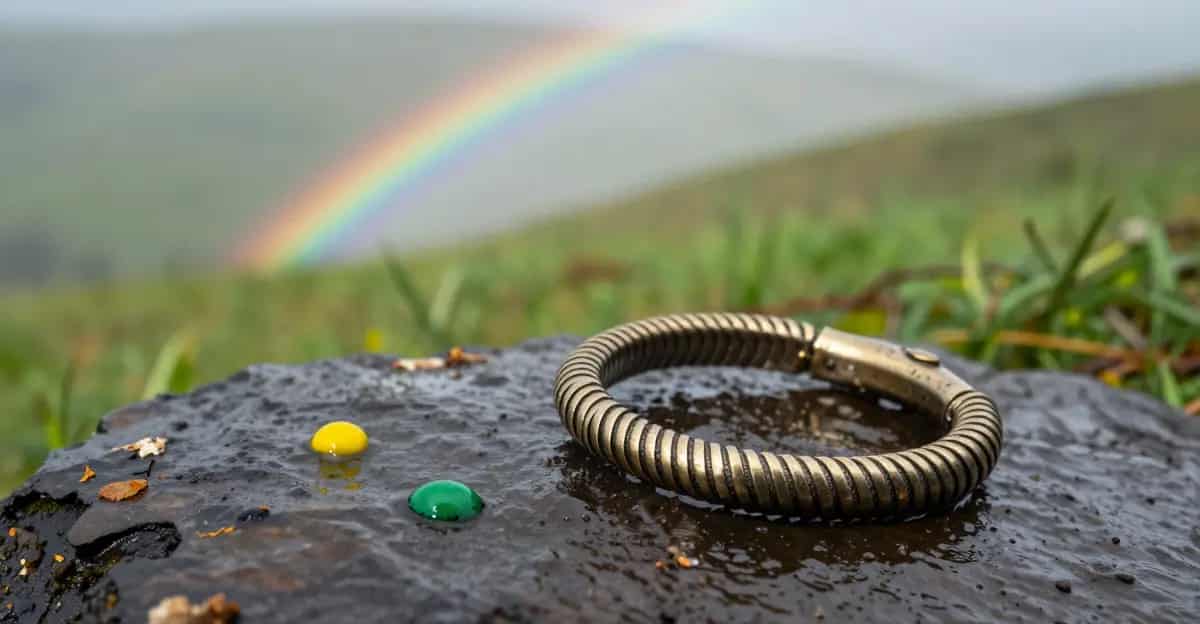
In another she is the horizon itself, the point where sky meets earth and sea. Silent and alone, she wants no husband: she wants to tend to her calling, making night fall on the horizon with the magic of her gourd, the adô. When Nana Buruku insists on the marriage, Euá asks her brother for help, and Osumare, the Rainbow, keeps her at the far point where the arc of his body ends, behind the horizon, where Nana Buruku can no longer reach her (Prandi, myth "Euá é escondida por seu irmão Oxumarê"). In the myth of disillusion, she herself asks her father for a place where no man can ever see her again, and Obatala gives her the kingdom of the dead (Prandi, myth "Euá se desilude com Xangô e abandona o mundo dos vivos").
Do you see the pattern? Spring, mist, horizon, cemetery: places of passage, where something stops being what it was. And in all of them, Yewa refuses to be merely seen.
The keeper of the cemetery
Being keeper of the cemetery does not make Yewa a gentle figure. In one myth, Shango dances and plays the drum on a foggy morning, not knowing where he is. A female figure appears in the whiteness and asks why he dances there. Shango, arrogant as ever, answers that he dances wherever he pleases. She says that here she is the one who rules, and vanishes; the mist lifts and he sees the graves. Shango, who feared death and the eguns, runs away. Orunmila explains that the woman was Euá, keeper of the cemetery, and from then on Shango and his followers do not enter a cemetery (Prandi, myth "Euá atemoriza Xangô no cemitério").
Another myth gives her a warrior and dangerous side as well. As a hunter of great beauty, she blinded with poison anyone who dared look at her; married to Obaluaye, a jealous husband, she was locked by him in an anthill; the ants stung her almost to death and left her disfigured, and he covered her with red raffia (palha da costa) to hide it, so that everyone would still remember the beautiful huntress she had been (Prandi, myth "Euá é presa no formigueiro por Omulu").
In the myth of disillusion, the same world of the dead appears as work shared among several Orishas: it is Yewa who hands over to Oya the bodies of those who die; Obaluaye leads these dead to Orisha Oko, who devours them so that they return to the earth of Nana Buruku, from which they were once made. Nobody disturbs Euá in her cemetery (Prandi, myth "Euá se desilude com Xangô e abandona o mundo dos vivos").
Whoever guards the passage also saves
One myth ties Yewa to the theme of our Friday Study. Orunmila, the babalawo, is fleeing Death, Iku, who pursues him across every field. He reaches a river and sees a beautiful woman washing clothes: it is Euá. She hides him under the washing board, which was in fact an Ifá divination tray turned upside down, and goes back to washing and singing as if nothing had happened. When Death arrives, breathless, Euá says he crossed the river long ago and is more than forty rivers away. Death gives up. The myth ends in celebration, with everyone singing that Euá delivers from Death (Prandi, myth "Euá livra Orunmilá da perseguição da Morte").
The woman who rules the cemetery is the same one who, on a riverbank, tricks Death to save someone on the run. Whoever knows the passage also knows the detour.
What these myths leave us
Read together, the myths form an argument: Yewa is neither a beauty to be possessed nor a mystery to be solved. She becomes water to save her children, becomes mist to escape those who fight over her, hides on the horizon to live as she wishes and takes the cemetery as her kingdom. Each withdrawal comes with a calling: the spring quenches thirst, the mist guides the undecided, night falls from her adô, and the dead have someone to look after them.
What we learn from her is a lesson in contemplation: not everything beautiful needs to be possessed, and not everything sacred needs to be explained. Where the myth says something is her secret, the honest answer of a student is to leave the secret where it is.
Source of this text: myths gathered by Reginaldo Prandi in Mitologia dos Orixás (Companhia das Letras, 2001), chapter on Euá, and Pierre Verger's record in Orixás (p. 69). We retell in our own words; we do not reproduce the texts.
What you have read here is rooted in the 256 Odus of Ifá — the corpus we study verse by verse. Read them as contemplation: real divination belongs at the table of a consecrated babalawo.
Sources consulted
- Mitologia dos Orixás — Reginaldo Prandi
- Orixás — Pierre Fatumbi Verger, p. 69
Written by
- Pablo de Lima (Awofakan)
- Thaiana de Lima (Ikofá)
A couple initiated in Ifá in the Cuban lineage — Regla de Ocha / Ifá.
Meet the authors →Last reviewed:
Get the wisdom in your inbox
One new article a week on Orishas, Odus and Yoruba philosophy. No spam.
Unsubscribe anytime, one click from any email.
Comments
Loading comments...
You need to sign in to comment.