Shango (Xangô): Orisha of Justice, Thunder and Sacred Fire
Kaô Cabecilê! Shango (Xangô) is the King of the Yoruba pantheon — Orisha of justice, thunder, lightning and sacred fire. He was a human being, the fourth Aláàfin (king) of the ancient kingdom of Oyo in present-day Nigeria, and became an Orisha after his death. His story is one of the best-documented in the pantheon and spans centuries: from the Empire of Oyo in the 14th-15th centuries to the Afro-Brazilian diaspora, from Cuban Santería to the temples of Salvador, Recife and Rio.
Who is Shango
Shango (in Yoruba: Ṣàngó) is the sovereign Orisha of justice and balance. Wherever there is a hard decision, a judgment to make, legitimate authority or the need for a firm answer, Shango is there. His power is not raw force — it is the strength that knows when to act.
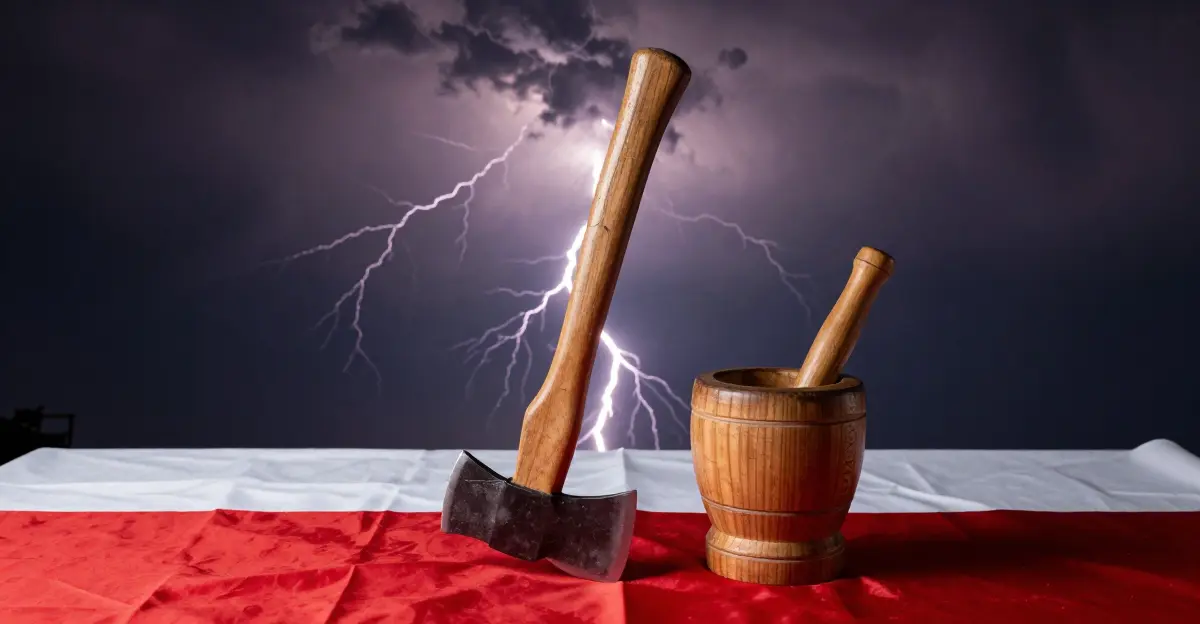
Unlike Ogun, who clears the path with a sword, Shango judges before acting. His instrument is the oxê — the double-headed axe — and each blade represents one side of every question. Before deciding, both sides must be heard. This is the essence of Sangonist justice.
In history, Shango was the fourth Aláàfin of Oyo, known for his magnetic power, his political wisdom and his explosive temperament. Married to Oya (Orisha of winds and storms), Oshun (of fresh waters) and Oba (of the Oba river), he ruled one of the greatest empires of West Africa before transcending to become an Orisha. It is said that, upon his death, he ascended to the heavens through lightning — and ever since, every clap of thunder is his voice and every flash of lightning his presence.
Sacred Attributes
Everything about Shango speaks of fire, red, gold and power:
- Colors: red and white, also gold and fire-brown
- Symbols: the oxê (double-headed axe), the xerê (gourd rattle), thunder stones (meteoritic rocks), the royal throne
- Day of the week: Wednesday
- Main votive food: amalá — okra cooked with dried shrimp, palm oil and pepper, served over pounded yam
- Drink: aluá (fermented corn or pineapple drink)
- Elements: fire, thunder, lightning, the quarry
- Stones: thunder stone, garnet, red agate
- Greeting: Kaô Cabecilê! (literally "come, bow your head before the king!")
The classic image portrays Shango as a strong man dressed in red and white, wearing the royal crown, with the oxê in his right hand and the xerê in his left. In many houses, 6 or 12 cowrie shells are placed on the ceremonial drums — a number associated with the totality of his reign.
Syncretism and Feasts: Saint Jerome in Brazil, Saint Barbara in Cuba
Devotion to Shango built different bridges on the two shores of the Atlantic — and confusing them is the commonest mistake made about this Orisha.
In Brazil, Xangô is Saint Jerome. The dominant syncretism in Candomblé Ketu and in the Batuque of Rio Grande do Sul is with Saint Jerome, celebrated on September 30 — the translator, doctor of the Church, bound to study, to the word and to judgement. In houses of the Northeast, Xangô also appears linked to Saint John (June 24) and Saint Peter (June 29), through the bonfires and the thunder.
The votive food is amalá — okra with meat, served in a wooden bowl or over the mortar. In Recife and Olinda, Xangô's caruru gathers the community to eat seated on the ground, without cutlery, sharing one meal: one of the tradition's most beautiful rituals, and the clearest translation of what this Orisha means by abundance.
In Cuba, Changó is Saint Barbara. In Santería the syncretism is with Saint Barbara, whose feast is December 4 — the saint with the red cloak, the sword and the tower, associated with lightning. It is one of the island's largest festivals, and her image with the raised sword is, for the Cuban devotee, the very face of the King of Oyo.
And in Brazil, December 4 belongs to Iansã. Here is the confusion that runs through half of what is written on the subject: in Brazil, Saint Barbara is syncretized with Iansã, not with Xangô. The great feast of the Pelourinho and of the Mercado de Santa Bárbara, in Salvador, is hers. The same saint, the same lightning, and two readings depending on which shore of the Atlantic — which is not a contradiction but history: each community chose, among the saints available, the one that best hid its own.
Mythology (Itans)
The Ese Ifá and the Yoruba Itans tell dozens of stories about Shango. Three are essential.
The King who became an Orisha
Shango was the fourth Aláàfin of the Kingdom of Oyo. He governed with strength and wisdom, but he was also temperamental and ambitious. Tradition holds that, in a moment of fury, he cast a curse upon his own palace — and lightning fell, destroying it. Overcome with shame, he withdrew into the forest and disappeared. His subjects, finding only his royal cloak and his crown, understood that he had ascended to Orun (the heavens) through the lightning itself.
This story teaches the dialectic between power and responsibility: the sovereign who does not control his fire destroys himself. Shango reminds us that the greatest battle of those with power is the battle with themselves.
The Judgment of Shango
When two men came to dispute a piece of land, both claiming to be the rightful owner, Shango listened to each one for three days, in silence. At the end, he commanded both to swear upon his oxê. The one who lied was immediately struck by lightning — and the land went to the one who told the truth. Ever since, swearing on Shango's oxê is the most serious oath a Yoruba can take.
Shango's justice has no friends. He does not negotiate with lies, even when the liar is one of his own devotees.
The Thunder Stones
When Shango casts a lightning bolt, he leaves a thunder stone on the earth — a black or meteoritic stone that has become a sacred symbol. In Africa and in Candomblé houses, these stones are guarded with extreme care: they contain the direct ase of the Orisha. In olden times, finding a thunder stone in the field was a sign that Shango had visited that land.
Shango Across Cultures: Nigeria, Cuba, Brazil
The energy of Shango crossed the Atlantic and was preserved under slightly different names but with the same core: justice, thunder, sovereignty.
1. In Nigeria — Yoruba Tradition
In Yoruba land, Ṣàngó continues to be venerated in the royal temples of Oyo (currently a city in the homonymous state). His title is Aláàfin — Lord of the Palace. His priests, called Mogba, are guardians of oral traditions reaching back centuries.
2. In Cuba — Santería / Regla de Ocha
In Cuban Santería, he is Changó (or Shangó), and he is one of the most popular figures of the entire tradition. Syncretized with Saint Barbara, he shares colors (red and white) and attributes (lightning, sword, tower). His feast in Cuba is December 4 — a date that in Brazil belongs to Iansã. He is invoked for matters of strength, victory over enemies, justice in legal proceedings and romantic conquests.
3. In Brazil — Candomblé and Umbanda
In Candomblé, Xangô is one of the most venerated Orishas, especially in the Ketu and Jeje-Nagô traditions. Each nation has variations: the Xangô of Pernambuco preserves specific titles such as Xangô Airá, Xangô Aganju and Xangô Obakossô.
In Umbanda, Xangô leads the Line of Justice and is invoked in any situation involving courts, important decisions, unjust authority to be confronted, or judicial proceedings. His children typically exhibit natural leadership, a sharp sense of justice, personal magnetism and a strong but controlled temperament.
How to Honor Shango
For those who wish to approach Shango with respect, without the need for formal initiation:
- Act with integrity in small judgments. Shango is honored more by telling the truth when it costs than by grand offerings. Do not slander. Do not favor injustice.
- Offer amalá on Wednesdays. Even a simple plate of okra with palm oil left on a home altar with a stone is a form of greeting.
- Wear red and white on Wednesdays. A silent way to honor him in daily life.
- Care for stones. Collect significant stones from quarries or keep a thunder stone if you find one — they carry the Orisha's ase.
- In moments of injustice, invoke him. Say "Kaô Cabecilê, bring your justice." Not to ask for vengeance — Shango is not vindictive — but to ask for clarity, strength to face what must be faced, and protection against slander.
"Shango's justice has no friends. But it has judgment."
Kaô Cabecilê! May the King of the Orishas grant you the courage to judge with firmness, the wisdom to hear both sides, and the self-control to ensure your own fire never consumes you.
What you have read here is rooted in the 256 Odus of Ifá — the corpus we study verse by verse. Read them as contemplation: real divination belongs at the table of a consecrated babalawo.
Sources consulted
- Mitologia dos Orixás — Reginaldo Prandi
- Orixás — Pierre Fatumbi Verger, pp. 87–94
Written by
- Pablo de Lima (Awofakan)
- Thaiana de Lima (Ikofá)
A couple initiated in Ifá in the Cuban lineage — Regla de Ocha / Ifá.
Meet the authors →Last reviewed:
Get the wisdom in your inbox
One new article a week on Orishas, Odus and Yoruba philosophy. No spam.
Unsubscribe anytime, one click from any email.
Comments
Loading comments...
You need to sign in to comment.