Ibeji: The Twin Orishas Who Outwitted Death
Introduction
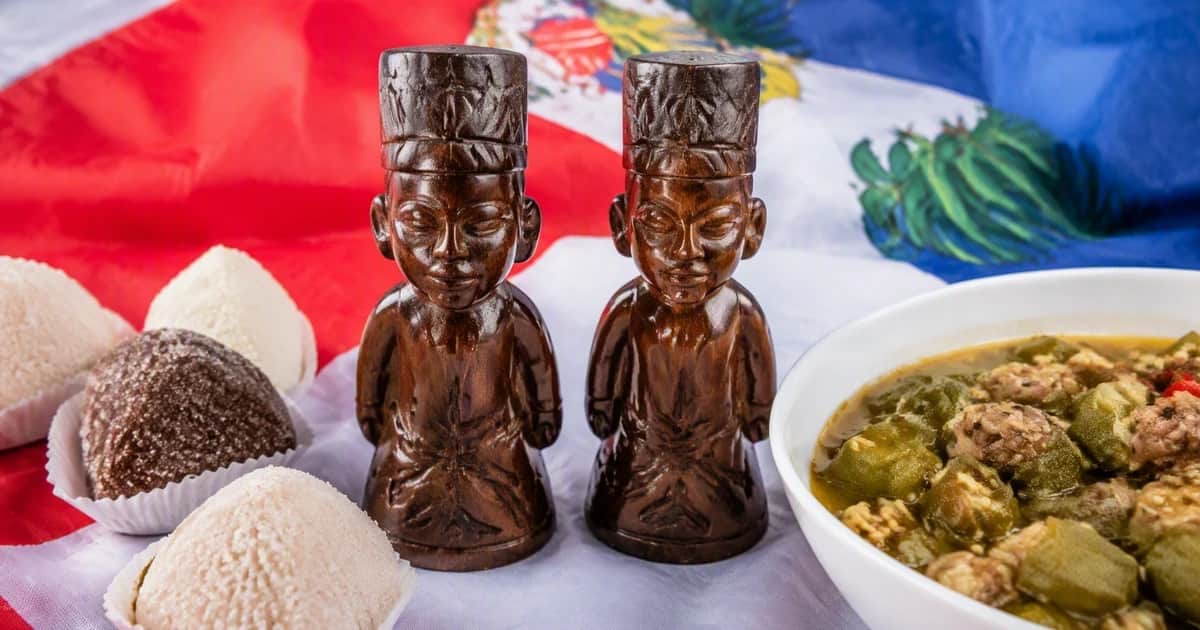
Among the most celebrated Orishas in Brazil is not a warrior or a queen of the waters — it is two children. The Ibeji, the sacred twins, appear in almost every Candomblé house as statuettes of two boys or two girls, always in pairs, always at play. Prandi collects, in his Mitologia dos Orixás, eight myths about them — and no two fully agree on where the Ibeji come from. It is one of the pantheon's most beautiful divergences: the twins have more than one origin because they are, themselves, duplicity in person.
Children of whom? The myths disagree
In the myth "Os Ibejis nascem de Oiá e são criados por Oxum", they are two of the sixteen children Oiá had with Oshosi — raised by Oshun, Oshosi's first wife, who had no children of her own. In "Os Ibejis são transformados numa estatueta", they are children of Yemoja. In "Os Ibejis brigam por causa do terceiro irmão" and in "Os Ibejis enganam a Morte", they are children of Oshun — and, in the latter, of Shango as well. Prandi himself does not pick one version: he records the several, as oral tradition always has. Here we do the same — we show the divergences rather than resolving them in favor of one.
A statuette made to play forever
One of the pantheon's saddest myths explains why the Ibeji almost always appear as two wooden figures, identical, inseparable. Children of Yemoja, the two boys played every day with Logunede and with Ewa — until, at a waterfall, one of them drowned. The surviving twin wasted away from grief and loneliness, and went to beg Orunmila to bring his brother back. Orunmila could not — or would not — restore the dead boy's life, but he turned the two into wooden images and ordered them to stay together forever, playing, never growing, never separating again (Prandi, myth "Os Ibejis são transformados numa estatueta"). It is this image — two children eternally together — that still sustains the custom of never separating the pair of Ibeji statuettes on a shrine.
The Ibeji outwit Death
The most famous myth is also the one that explains why the Ibeji have a reputation for power despite their size. Children of Oshun and Shango, raised by Yemoja, the twins lived to play and beat small magical drums their adoptive mother had given them. It was then that Iku, Death, set traps on every road and began devouring humans before their time — old people, children, no one escaped her hunger. Priests, sorcerers and diviners tried to stop her and were all defeated.
The Ibeji hatched a different plan. One of them walked the dangerous path playing his little drum with such joy and skill that Death herself, enchanted by the music, warned him of the trap instead of killing him — and began dancing, unable to stop. Meanwhile the other twin, hidden in the bush, swapped places with his brother whenever he tired, without Iku ever noticing the exchange. The music never ceased, and Iku danced and danced until she could bear it no longer. Exhausted, she begged them to stop — and the Ibeji agreed only on one condition: that Death swear to remove every trap from every road. Iku had no choice. That is how the twins beat the one no other Orisha had managed to beat (Prandi, myth "Os Ibejis enganam a Morte").
The drought, the well, and the thirst quenched
A third myth shows the other side of the Ibeji: not the power to defeat Death, but the kindness to rescue a people. During a great drought, with death by thirst already stalking the village and every adult failing in the search for water, it was the twins — digging holes in the yard, playing as always — who found an underground spring and quenched the thirst of the whole town (Prandi, myth "Os Ibejis encontram água e salvam a cidade"). It is a short myth, almost an aside, but it completes the portrait: the Ibeji help by playing, not despite it.
Saints Cosmas and Damian: Brazil names the twins
In Brazil, popular devotion drew the Ibeji close to the Catholic saints Cosmas and Damian — twin brothers, physicians and third-century martyrs, celebrated on September 27. The association is so strong that, on that date, it is common to see children in the streets receiving sweets and caxixi rattles in the name of the "twin saints" — a feast that, at its root, is an offering to the Ibeji in Catholic disguise, the same syncretism mechanism that hid Ogun behind Saint George and Oshun behind Our Lady Aparecida. (to confirm against the primary source: the exact historical origin of the Ibeji–Cosmas and Damian pairing in Bastide, "O Candomblé da Bahia".)
In Cuba, the Lucumí tradition knows the twins as Jimaguas or Ibeji, linked to Shango and Oshun along the same line Prandi records for Brazil. (to confirm against the primary source: whether Santería also pairs them with Saints Cosmas and Damian — the divergence or coincidence between the two Catholic traditions remains an assumed gap pending verification in Cabrera, "El Monte".)
What this teaches
The Ibeji do not impress by force, like Ogun, or by beauty, like Oshun — they impress by being double: two bodies with a single fortune, a single game, a single fate. When one dies, the other does not survive whole without him; when one tires, the other carries on the same music without anyone noticing the swap. Perhaps that is why the tradition treats them as child-Orishas rather than warriors: their power is not individual — it is what only exists when two stay together.
What you have read here is rooted in the 256 Odus of Ifá — the corpus we study verse by verse. Read them as contemplation: real divination belongs at the table of a consecrated babalawo.
Sources consulted
- Mitologia dos Orixás — Reginaldo Prandi
Written by
- Pablo de Lima (Awofakan)
- Thaiana de Lima (Ikofá)
A couple initiated in Ifá in the Cuban lineage — Regla de Ocha / Ifá.
Meet the authors →Last reviewed:
Get the wisdom in your inbox
One new article a week on Orishas, Odus and Yoruba philosophy. No spam.
Unsubscribe anytime, one click from any email.
Comments
Loading comments...
You need to sign in to comment.