Iroko, the Tree Orisha: the Promise, the Gameleira and the Ceiba
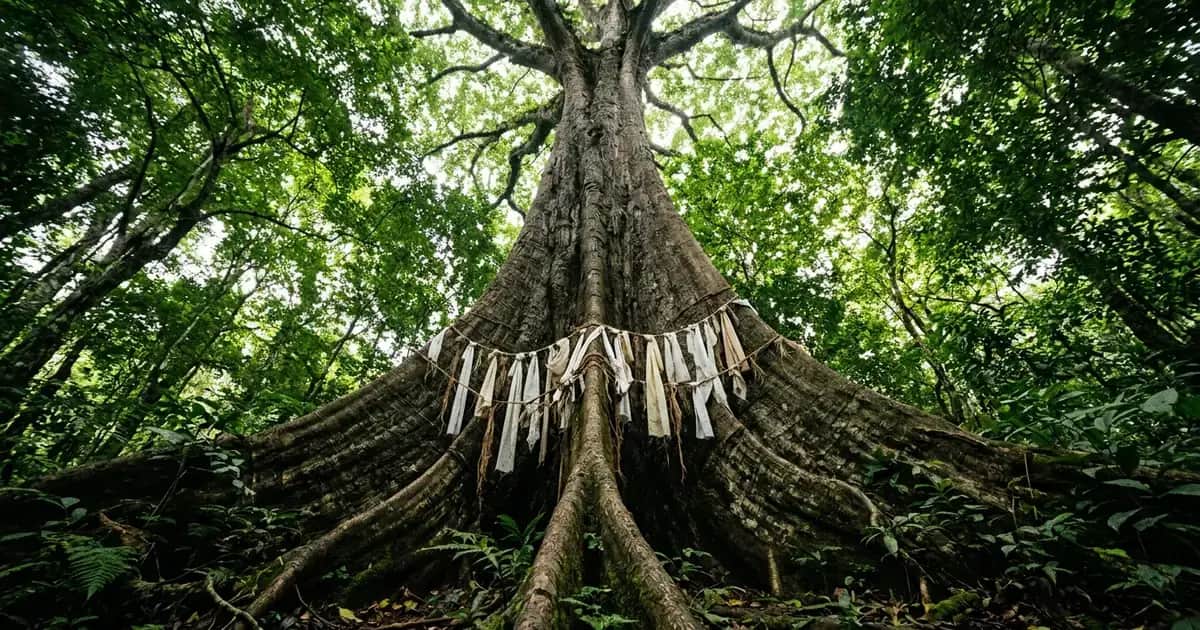
In some terreiros, the oldest tree on the grounds is not treated as scenery. Pieces of white cloth hang from its branches, bottles, dishes and vessels sit at its foot, and nobody cuts a branch from it (this is the scene Roger Bastide describes, PDF p. 90). That tree bears the name of an Orisha: Iroko. This text reads what the sources we have say about him, the three myths Reginaldo Prandi gathered in his chapter, and what happened to Iroko when he crossed the sea to Cuba, where the tree that gave him his name did not grow.
What the sources say he is
The glossary of Mitologia dos Orixás (Prandi spells it Iroco; we use Iroko, the site's form) defines Iroco as a sacred African tree, Chlorophora excelsa, home of Oro, the spirit of the forest. In Brazil, Prandi says, its place was taken by the gameleira-branca, which the old candomblés of Bahia and Pernambuco worshipped as an Orisha (Prandi, glossary, PDF p. 841). In the book's introduction the author adds two things: that many candomblés include Iroco in their pantheon, picturing him as an ancient tree whose leafy crown shelters birds feared as carriers of witchcraft, and that his cult in Brazil is rare (Prandi, PDF p. 29).
Roger Bastide, in O Candomblé da Bahia, describes the same tree from the side of ritual. The gameleira-branca identified with Iroco is prepared the same way a sacred stone or a filha de santo is prepared: the deity is fixed in it, and from then on nobody may touch it. The account he brings also says that if anyone cut its branches, blood would run from them. In Recife, he notes, songs were sometimes sung for Iroco at certain festivals, but this Orisha had no children and manifested in no one (Bastide, O Candomblé da Bahia, PDF p. 90). Keep that detail in mind: one of the myths says otherwise.
A caution before the myths. Iroko is often called the "lord of time." In the works we consulted, we did not find that title. What one myth does state is more concrete: Iroco was the first tree planted at the beginning of time, older than the mahogany, the kola tree and the cotton tree (Prandi, myth "Iroco castiga a mãe que não lhe dá o filho prometido"). It is a matter of seniority, and that is all that can be said with a source.
Olurombi's promise
In the first myth, the spirit who lived in the oldest of Iroco's trees was feared by everyone: he frightened hunters at night with a torch and drove mad anyone who looked him in the face. At a time when no woman in the village could conceive, the women gathered around the trunk, backs turned to it, and asked for children. Each promised what her husband could give: corn, yams, fruit, goats, rams. Olurombi, the wife of a woodcarver, had none of these. In her despair she promised her firstborn.
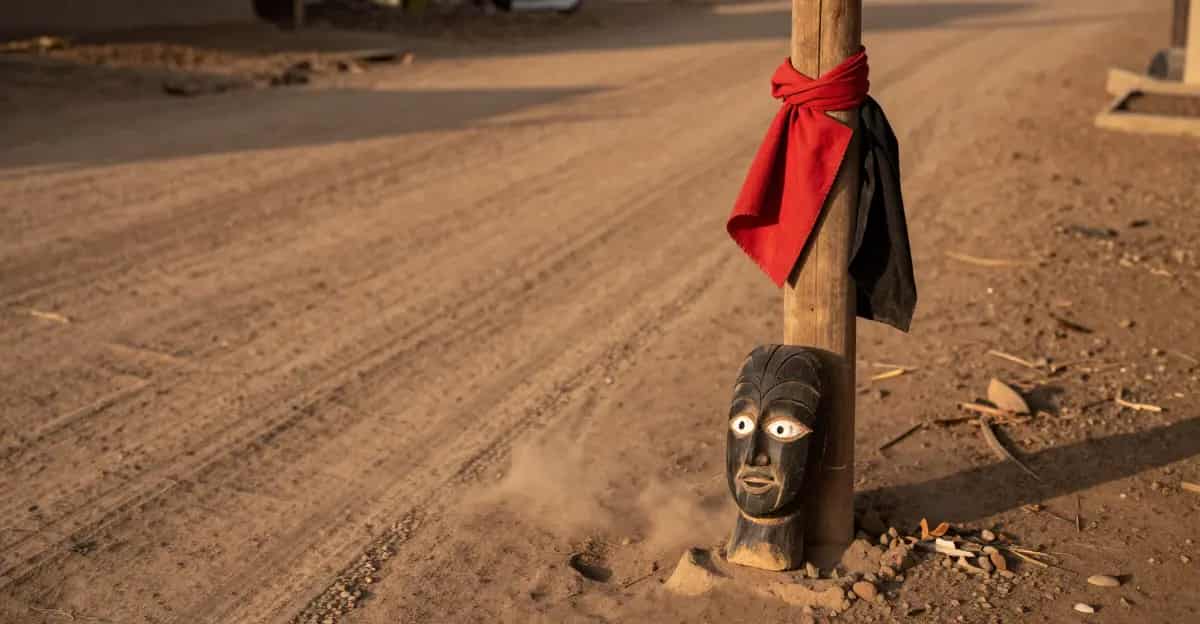
The children were born, the offerings were paid, and Olurombi could not bring herself to hand over the boy. Years later Iroco met her on the road and turned her into a bird trapped in his own crown. The bird sang a song about the promises that were kept and the one that was not. When the carver heard it, he understood everything. He neither handed over his son nor ran from the debt: he chose the finest log from Iroco's own tree and carved a boy with his son's features, always smiling. Iroco was delighted, because that wooden boy was the only one who looked him in the face without fear. He gave Olurombi back her woman's form, and the family returned with offerings and colored cloth to adorn the trunk (Prandi, myth "Iroco castiga a mãe que não lhe dá o filho prometido").
The only one who could face Iroco was made of Iroco's own wood. The debt was paid with work and with art.
The witch and the ordinary woman
The second myth brings a different Iroco: a handsome, strong man who came down from Orun to Aiye with two sisters, Ajé the witch and Ogboí, an ordinary woman. He went to live in a tree; they, in houses. Ogboí had ten children; Ajé had only one, a little bird. When Ajé travelled and left her child with her sister, the nephews killed and ate it. Ajé ran to Iroco's tree, and from there he struck Ogboí's children until their mother offered sacrifice to save the ones who were left. The myth ends by saying that Iroco lives in the gameleira-branca and dispenses justice in the dispute between witches and ordinary women (Prandi, myth "Iroco ajuda a feiticeira a vingar o filho morto"). In his notes Prandi says he took this myth from Osamaro Ibie (Prandi, PDF p. 811).
The clean body
In the third, a childless woman goes to the babalawo, who sends her to bring an ebo to Iroco's tree. She does almost everything: she decorates the trunk with cloth bows and lays down the offering. She forgets only the rule of keeping away from her husband for the three days before. Iroco opens a mouth in his trunk and swallows her up to the shoulders. The village runs to see, the babalawo casts and points to the fault, and because the woman repents, the tree lets her go. She conceives, gives thanks with her body kept clean, and when the boy is born the babalawo says he must be initiated to Iroco. Ever since, the myth says, the trunk has stayed adorned and offerings never lack at its feet (Prandi, myth "Iroco engole a devota que não cumpre a interdição sexual").
Here is the divergence we promised. Bastide records an Iroco with no initiated children in Recife; the myth ends with a child initiated to him. Both are records, and both stay here.
In Cuba, the ceiba
Lydia Cabrera heard from the elderly informants of El Monte that there was no iroko in Cuba. The ceiba reminded the Lucumí of the great tree of the African coast, and they named and consecrated it with that name. Some said Iroko lives in the ceiba; others, that Iroko is the ceiba itself (Cabrera, El Monte, PDF p. 80). On the same page an informant describes Iroko as a male saint, and an old one.
Cabrera also tells a legend that is almost the myth of Olurombi with another ending. Erubbá, a fruit seller, asked the ceiba every day for a child to keep her company and promised a ram in return. A girl was born, and Erubbá forgot the promise. One day, passing by with the girl, she saw Iroko dance: the roots opened a hole and the earth swallowed the child while the mother offered everything, too late. Right after, in parentheses, the book adds a correction: the one who gives children to women is not Iroko but Boma (Cabrera, PDF p. 83).
And in Nicolás Angarica's Lucumí manual, Iroco appears as a female saint, "hembra," a path of Obatala who lives at the top of the ceiba, away from noise (Angarica, PDF p. 25). The Iroco of Ibie's myth is a man; Angarica's is a woman. We do not settle the difference by picking a side: these are distinct traditions, and each records its own Iroko.
What Iroko asks for
Read together, the myths make an argument. Iroko gives what is asked, but he collects exactly what was promised, and he also collects the manner of approaching him. Olurombi owes a child; the devotee owes a body kept clean; Ogboí was meant to guard the nephew her sister entrusted to her; Erubbá, in Cuba, owes a ram. In every case the danger does not come from the request; it comes from the word given and forgotten.
There is also a lesson about how to pay. The carver does not settle the debt by outwitting Iroko but with the best of his craft, made from the wood of the tree itself. The devotee does not escape by denying the fault: she escapes because she repents. The oldest tree in the world, in these myths, wants the promise kept in full.
If you know the site's page on Iroko, these myths are its background: the tree that keeps, under its shade, what was promised.
Source for this text: myths gathered by Reginaldo Prandi in Mitologia dos Orixás (Companhia das Letras, 2001), Iroco chapter, plus the book's glossary and introduction; Roger Bastide, O Candomblé da Bahia (1961); Lydia Cabrera, El Monte (1954); Nicolás Valentín Angarica, Manual del Oriaté. PDF pages. Retold in our own words.
What you have read here is rooted in the 256 Odus of Ifá — the corpus we study verse by verse. Read them as contemplation: real divination belongs at the table of a consecrated babalawo.
Sources consulted
- Mitologia dos Orixás — Reginaldo Prandi, PDF pp. 29, 811, 841
- O Candomblé da Bahia — Roger Bastide, PDF p. 90
- El Monte — Lydia Cabrera, PDF pp. 80, 83
- Manual del Oriaté — Nicolás Valentín Angarica, PDF p. 25
Written by
- Pablo de Lima (Awofakan)
- Thaiana de Lima (Ikofá)
A couple initiated in Ifá in the Cuban lineage — Regla de Ocha / Ifá.
Meet the authors →Last reviewed:
Get the wisdom in your inbox
One new article a week on Orishas, Odus and Yoruba philosophy. No spam.
Unsubscribe anytime, one click from any email.
Comments
Loading comments...
You need to sign in to comment.