Ogun: Warrior Orisha, Lord of Iron and Open Paths
Ogun is the primordial force that breaks open the way. If Eshu is the crossroads where the choice is made, Ogun is the blade that cuts through dense forest so that a road can exist at all. He is the Orisha of iron, of just war, of technology, of agriculture, and of every transformation that demands courage, sweat and resolve.
In the Yoruba tradition Ogun is not merely a warrior — he is the civiliser. It was Ogun who forged the first tools that let humanity till the soil, build cities and defend itself. Without Ogun there would be no progress. Without Ogun the forest would have swallowed the world.
Ogunhê! Patakori Ogum! — this is the greeting that echoes through the terreiros, through the Ilês, and through the hearts of all who know that a real victory is won with integrity.
Who is Ogun in Yoruba Philosophy and in Ifá?
In Yoruba cosmology, Ogun is one of the primordial Orishas — an Irunmole who descended to Earth at the beginning of creation. He is a son of Oduduwá (the mythical ancestor of the Yoruba) and a brother of Eshu, Oshosi and Oxalá, depending on the mythic lineage told.
Ogun stands for the principle of transforming action. Where Obatala (Oxalá) conceives the idea and Orunmila knows destiny, it is Ogun who takes it in his hands and makes it material. He is the sweat of creation, the spark of iron on the anvil, the war cry that comes before the conquest.
The Sacred Domains of Ogun
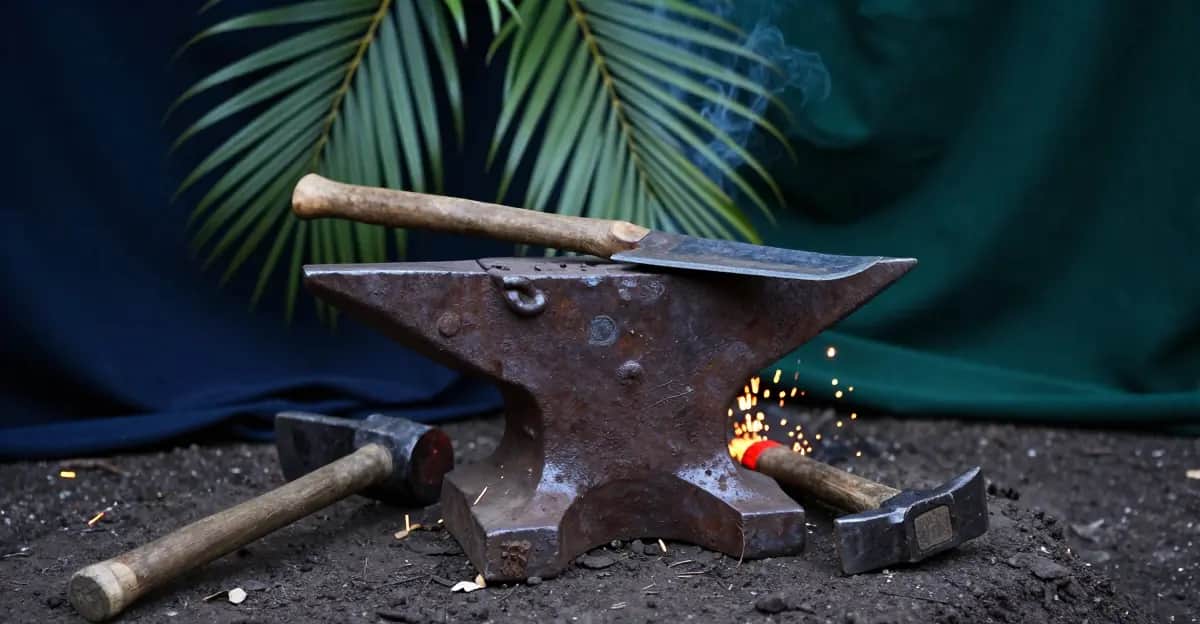
Iron and metalwork: Ogun is lord of all metal. From farming tools to weapons of war, from the surgeon's needle to the car's engine — everything made of iron belongs to Ogun. In the modern age, Ogun is the patron of technology, of engineering and of surgery.
War and justice: Ogun is not a warrior blind with rage. He fights only for just causes. In Yoruba philosophy, Ogun's war is always against oppression, lies and injustice. He protects the weak and punishes tyrants.
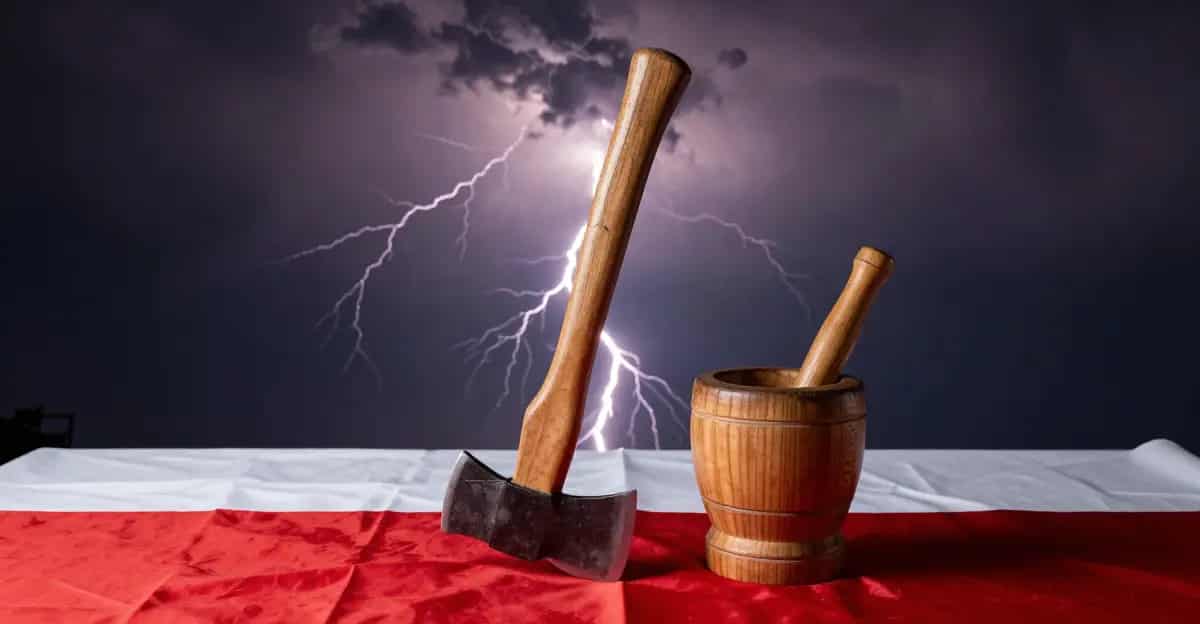
Agriculture and civilisation: Before he was a warrior, Ogun was a farmer. He taught humanity to clear the forest, prepare the ground and grow food. The hoe and the axe are as sacred to Ogun as the sword.
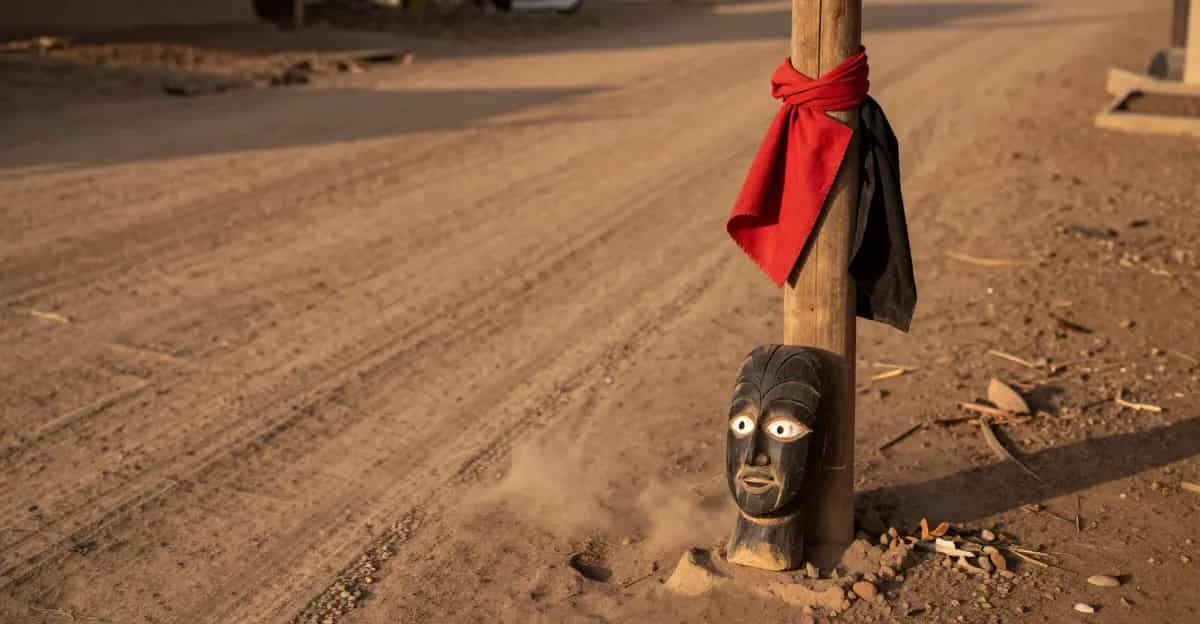
The physical paths: If Eshu governs the crossroads — the decisions — Ogun governs the roads themselves. He is the patron of travellers, of drivers, of lorry drivers, of everyone who covers ground.
The Itan (Story): Ogun and the Impenetrable Forest
When the Orishas decided to come down from Orun (the sky) to Aye (the earth), they met a terrible obstacle: the land was covered by a dense, impenetrable forest. No path existed. The Orishas, dressed in their fine cloth and their sacred ornaments, tried to cross the bush — and every one of them failed. Their garments tore, the thorns cut their divine skin, and no one could advance.
It was then that Ogun stepped forward. Wearing a skirt of mariwo (young palm fronds) and wielding his iron axe, Ogun entered the forest alone. With powerful, tireless blows he cut down every tree, every vine, every shrub. Sweat ran off his body like rivers. The iron of his axe sang against the wood.
When he was finished, Ogun had opened the first road in the world.
The other Orishas walked down the open road, treading clean earth, without dirtying themselves. They reached the land and were celebrated by the people. But Ogun, covered in sweat, leaves and blood, was left at the rear. No one thanked him.
Wounded by the ingratitude, Ogun swore: "Never again will I be anyone's servant. I will live alone in the forest, with my iron and my truth."
The Orishas, realising their mistake, begged Ogun to return. They offered him the crown of Irê, the city he had founded. Ogun accepted on one condition: that no one should ever forget that without work, without sweat and without sacrifice, no path opens.
Ogun Across Cultures: Nigeria, Cuba and Brazil
1. In Nigeria — Yoruba Tradition and Isese L'Agbaye
In his homeland, Ogun is venerated as the Orisha who founded the city of Irê-Ekiti (in present-day Ekiti State, Nigeria). He is the patron of hunters, blacksmiths, barbers, surgeons and everyone who handles metal tools. In many Yoruba communities the most solemn oaths are sworn on a piece of iron — to swear "by Ogun" is the most sacred commitment there is, because Ogun punishes liars without mercy.
2. In Cuba — Santería / Regla de Ocha
In Cuban Santería, Ogun is known as Ogún and is one of the four Guerreros (Warriors) that every initiate receives: Elegguá, Ogún, Ochosi and Osun. Ogún in Cuba is deeply bound up with hard work, perseverance and loyalty.
His representation includes a black iron cauldron (the caldero) holding miniature iron tools: the anvil, the hammer, the hoe, the axe, the sword and the shovel. This cauldron is kept by the front door, beside Elegguá, as protection against enemies.
3. In Brazil — Candomblé and Umbanda
In Candomblé: Ogun keeps his warrior and civilising essence. His feasts are marked by the powerful sound of the atabaques and by the vigorous dance of his children, who mime combat with imaginary swords. Offerings include feijoada, roasted yam, palm oil and dark beer (or red wine).
In Umbanda: Ogun is syncretised with Saint George (in Rio de Janeiro and most states) or Saint Anthony (in Bahia). In Umbanda, Ogun heads the "Line of Ogum" — a phalanx of warrior spirits that protect against envy, sorcery and spiritual attack. Its best-known entities include Ogum Megê, Ogum Rompe Mato and Ogum Beira-Mar.
The Sacred Attributes and Symbols of Ogun
Greeting: Ogunhê! Patakori Ogum!
Colours: dark blue and green (Candomblé Ketu) — dark blue and white (Angola/Jeje nations) — green and black (Cuba)
Main symbol: the sword (Idá) and the seven iron tools that stand for his domains: hoe, machete, anvil, hammer, sword, shovel and lance.
Offerings (adimús): feijoada (without dried shrimp), roasted yam with palm oil, dark beer, red wine, honey and grains of Selim pepper.
Day of the week: Tuesday — the day of action, of conquest and of hard work.
Sacred number: 7 — the seven tools, the seven paths.
Metal: iron — every iron object is sacred to Ogun.
The Sacred Oriki of Ogun — The Invocation
The Oriki is the poetic salute that calls on Ogun's energy, asking for his strength, protection and justice. It is recited firmly and with conviction — Ogun does not answer weakness.
In Yoruba
Ògún oníìrẹ, àṣẹ̀wọ̀ màjẹ̀sìn. Ògún gb'ẹni àyà, Ògún gb'ẹni ìjà. A lá tàtà ṣíré ògún, Sóde ọ̀run ní ń gbé. Ògún yẹ̀ yẹ̀ yẹ̀ — Ògún a dá fún owó àlàáfíà. Àṣẹ!
Translation
Ogun of Irê, he whose character cannot be broken. Ogun upholds the brave, Ogun upholds the fighter. He who plays with the sword as though it were a toy, who dwells beyond the sky. Ogun is bright, bright, bright — Ogun blesses with wealth and peace. Ase!
How it is used in practice: the Oriki of Ogun is recited before beginning any important work, before a battle (literal or figurative), and at dawn on a Tuesday. Many of Ogun's children recite it on waking, asking for strength and clarity for the day.
The Traditional Song — Orin Ògún
The Song — Call and Response
| Part | Words |
|---|---|
| Leader (who raises the song) | Ògún pá lélé o, akirí Lóòde! |
| Chorus (all answer) | Ògún pá lélé o, Ògún akirí Lóòde! |
What each sacred word means
Ògún — the name of the Orisha. It carries in itself the sound of metal on metal.
Pá lélé — "strikes with precision": his capacity to remove obstacles and enemies with surgical exactness.
Akirí — "he who ranges": his travelling nature, the pathfinder who never stops.
Lóòde — "through the town", "through the outer world" — Ogun does not stay at home. He goes out, ranges and conquers.
Poetic Translation
"Ogun strikes with precision — he who walks the world! Ogun strikes with precision — Ogun walks the world!"
Ogun in the Ifá Oracular System
When a reading of Ifá brings up an Odu governed by Ogun — or one in which he is the protagonist of the sacred stories — the message is always a call to decisive action. Ogun has no patience for hesitation, idleness or moral cowardice.
An Odu governed by Ogun usually carries warnings about:
- Immediate action: something in your life needs to be cut, removed or transformed. Do not wait — act now.
- Work as prayer: Ogun teaches that honest work is the most sacred form of prayer. No one asks for blessings without sweat.
- Justice: if you are suffering an injustice, Ogun promises justice — but he demands that you fight with honour, without tricks.
- Loyalty: Ogun tests loyalty. He wants to know whether you honour your commitments, keep your word and protect those who depend on you.
How to Honour Ogun's Energy Daily
Ogun is the Orisha most present in modern life. Every time you pick up a tool, drive a car, use a computer or fight for a just cause, Ogun is with you.
Honouring Ogun asks for no elaborate ritual. It is enough to live by these qualities: courage without cruelty, work without exploitation, justice without blind revenge, and loyalty without submission.
On Tuesday mornings you can simply give thanks for the work you have, for the tools that help you build your life, and for the strength to overcome the obstacles that the dense forest sets across your path.
Ogunhê! May Ogun's sword cut every evil from your path, and may his iron forge your victory with honour and with sweat.
What you have read here is rooted in the 256 Odus of Ifá — the corpus we study verse by verse. Read them as contemplation: real divination belongs at the table of a consecrated babalawo.
Sources consulted
- Mitologia dos Orixás — Reginaldo Prandi
- Orixás — Pierre Fatumbi Verger, pp. 40–49
Written by
- Pablo de Lima (Awofakan)
- Thaiana de Lima (Ikofá)
A couple initiated in Ifá in the Cuban lineage — Regla de Ocha / Ifá.
Meet the authors →Last reviewed:
Get the wisdom in your inbox
One new article a week on Orishas, Odus and Yoruba philosophy. No spam.
Unsubscribe anytime, one click from any email.
Comments
Loading comments...
You need to sign in to comment.