Oyeku Meji Meaning: Death, Transformation, Ancestors
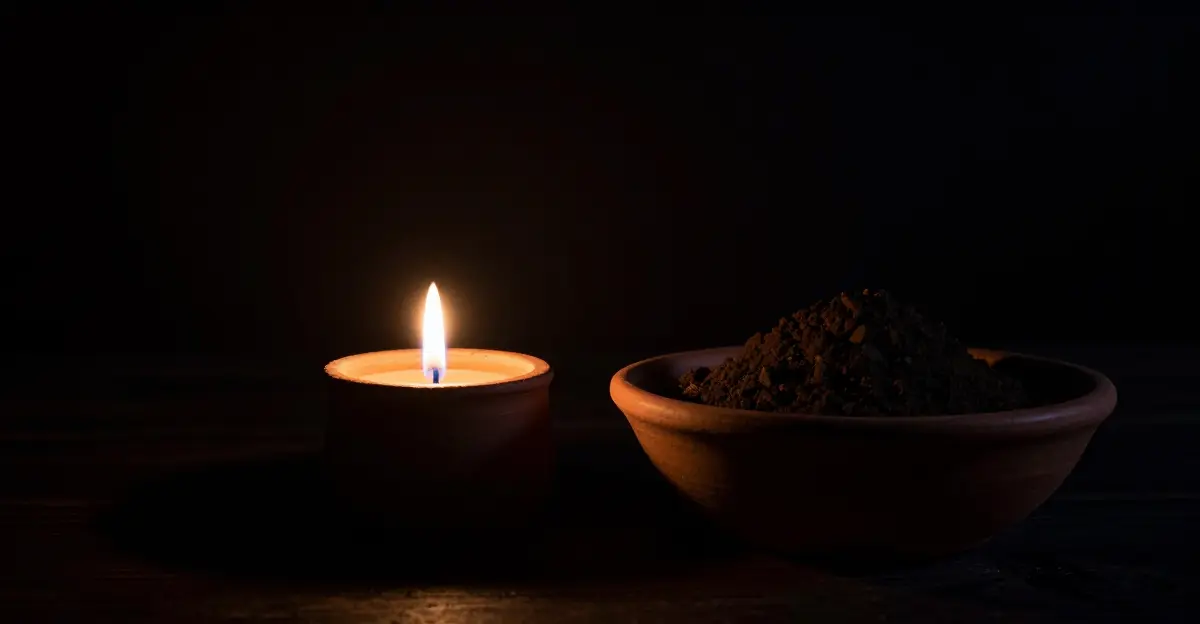
Mo júbà awọn Egungun! Oyeku Meji is the second of the 16 Meji Odus of the Ifá system, and its pattern on the Opele is 0000 0000 — four closed sides on each column, complete darkness. Where Eji Ogbe is absolute light, Oyeku Meji is fertile darkness. Where Eji Ogbe announces beginnings and openings, Oyeku Meji teaches about endings, transformation, and the invisible womb where everything that seems to die is, in fact, preparing to be reborn.
The Second Meji of the Ifá System
In the traditional pattern of the 16 Mejis, Oyeku Meji holds the second position — right after Eji Ogbe. This is no coincidence. The ancient Babalawos placed these first two Mejis in deliberate parallel: light and shadow, day and night, birth and death. Not as opposites in conflict, but as the same cosmic movement seen from two angles.
The Opele binary for Oyeku Meji is:
0 0 0 0 0 0 0 0
Four closed sides on both columns. It is the Odu of pause, of fertile silence, of the void that precedes form.
Literal and Philosophical Meaning of Oyeku
In Yoruba, Oyẹ̀kú has an etymological link to the idea of "death" (ikú) and to the transition between worlds. But it is a death that the Yoruba understand very differently from Western death: it is not the end — it is a doorway. When something "dies" in Oyeku, it is surrendering its current form so that a new one may arise.
Oyeku Meji rules:
- The darkness before dawn — the silence before the word
- The Ancestors (Egungun) — all those who have departed and continue to guide from the Orun
- Deep transformations — divorces, career changes, the end of long cycles
- Introspection — the necessary pause before any new beginning
- The cosmic womb — where everything not yet born is preparing
"Bí Oyẹ̀kú bá dé, kò sí àjò tí kò gbé wọlé" — When Oyeku arrives, no journey returns without bringing home with it.
Death as Transformation, Not as Ending
For the Yoruba tradition, death is not destruction. It is reconfiguration. Oyeku Meji is the Odu that teaches this most radically. When Oyeku appears in a consultation, it rarely speaks of literal death — it speaks of something that needs to die within you: a habit, a relationship, an illusion, a fear, an old version of yourself.
To deny symbolic death is to deny renewal. Whoever clings to what has already ended suffers. Whoever surrenders to silence what has already played its role makes room for the new. That is the central teaching of Oyeku Meji.
Oyeku and the Ancestors (Egungun)
Oyeku Meji is also the Odu par excellence of the Egungun — the ancestors. In Yoruba cosmology, the one who dies does not disappear; they become Egungun, an ancestral spirit that continues to influence the life of the family and the community.
To honor the Egungun is to cultivate memory, gratitude, and roots. When Oyeku Meji appears, it is often a call to:
- Cleanse the family altar or create a space dedicated to the ancestors
- Pray for your dead — for the grandparents, parents, and teachers who departed
- Offer votive food (fresh water, coffee, the favorite dish of the deceased)
- Ask the Egungun for guidance before major decisions
Ancestral force is real and tangible in the Yoruba tradition. Oyeku Meji reminds you that you are never alone — you walk with your entire lineage.
Oyeku Meji Across Traditions: Nigeria, Cuba and Brazil
The reading of the Odu Oyeku Meji preserves its essence across the three great traditions of the Yoruba diaspora, but the ritual focus shifts in each one.
1. In Nigeria — Yoruba Tradition
The Babalawos in Ilé-Ifẹ̀ and across all Yoruba communities interpret Òyẹ̀kú Méjì as the Odu of ancestral continuity. When it falls in a consultation, it is common to prescribe an Ebó for the Egungun: offerings at the family altar, the sacrifice of white birds and the recitation of the names of up to seven generations of ancestors. The Yoruba patrilineal lineage is fundamental here — Oyeku connects you to your orí inu (inner Orí) through your departed parents and grandparents.
2. In Cuba — Santería and Cuban Ifá
In Cuban Santería, Oyeku Meji (written Oyekun Meyi) is considered one of the most serious Odus. When it appears, it often signals the need for a misa espiritual — a session of communication with the family's deceased, led by an Espiritista. Cuba developed a unique tradition of cross-pollination between Ifá and Kardecist Spiritism, and Oyeku is one of the Odus where this synthesis is most clearly visible.
3. In Brazil — Candomblé and Umbanda
In Candomblé, Oyeku Meji is linked to the cult of Egungun preserved mainly on Itaparica Island (Bahia) and in houses of the Egba tradition. The Egungun manifestations are rare, profound, and require specific initiation. In Umbanda, the energy of Oyeku resonates with the Linha das Almas (or Linha de Pretos-Velhos) — ancestral spirits of formerly enslaved elders who bring wisdom, patience and emotional healing to those who consult them.
Messages of Ire (Blessing) and Osogbo (Warning)
Like every Odu, Oyeku Meji carries two sides: Ire (the blessing) and Osogbo (the warning).
Ire of Oyeku Meji
- Protection of the Ancestors — you are being guarded by an invisible force
- Deep renewal — what is ending now opens space for something better
- Silent wisdom — your inner voice is clear, listen to it
- Healing of old wounds — long cycles come to an end and set you free
Osogbo of Oyeku Meji
- Resistance to the natural ending — clinging to what has already died causes suffering
- Neglect of the Egungun — failing to honor the ancestors brings imbalance
- Depression and isolation — purposeless darkness, instead of fertile darkness
- Spiritual procrastination — postponing necessary transformations
The difference between Ire and Osogbo in Oyeku is a choice of attitude: to accept symbolic death or to resist it.
When Oyeku Meji Appears in a Consultation — What Does It Mean?
For anyone studying Oyeku Meji — or who received it at a babalawo’s table — these questions remain:
- What needs to end in my life right now?
- Is there an ancestor calling for attention that I am ignoring?
- Which old version of myself am I still carrying unnecessarily?
- Am I confusing the fertile pause with sterile depression?
The honest answer to these questions is the beginning of the work with Oyeku Meji.
"Where there is darkness, there is also a womb. Where there is an ending, there is also a doorway. Whoever trusts in Oyeku is reborn."
Mo júbà awọn Egungun. May the ancestors guide you in the transformation that needs to happen.
What you have read here is rooted in the 256 Odus of Ifá — the corpus we study verse by verse. Read them as contemplation: real divination belongs at the table of a consecrated babalawo.
Sources consulted
- Sixteen Great Poems of Ifá — Wándé Abímbọ́lá, p. 29
- Ifa Divination — William Bascom, pp. 40–50
Written by
- Pablo de Lima (Awofakan)
- Thaiana de Lima (Ikofá)
A couple initiated in Ifá in the Cuban lineage — Regla de Ocha / Ifá.
Meet the authors →Last reviewed:
Get the wisdom in your inbox
One new article a week on Orishas, Odus and Yoruba philosophy. No spam.
Unsubscribe anytime, one click from any email.
Comments
Loading comments...
You need to sign in to comment.