Consulting Ifá: 20 frequently asked questions, answered with sources
People who come to Ifá for the first time usually bring the same questions: who casts, with what, how much it costs, whether the problem has to be told, whether the answer is the future. We have gathered twenty of them here. The answers come, almost all of them, from the book in which William Bascom describes Ifá divination on the basis of fieldwork in Yorubaland, above all in Ife (Bascom, Ifa Divination, p. 3), and they are cross-checked against Wándé Abímbọ́lá, Pierre Verger and Roger Bastide. Where the source does not answer, we say so.
One caveat before we begin: this site does not give consultations. We describe what the sources record about the babalawo's table; anyone who wants to be consulted should go to a babalawo.
What it is and who does it
1. What is Ifá, in one sentence?
Bascom opens his book with a dry definition: Ifá is a system of divination based on sixteen basic and 256 derivative figures, the Odus, obtained with sixteen palm nuts or with the cast of a chain of eight half seed shells (Bascom, Ifa Divination, p. 3). On the same page he notes that Ifá is also worshipped as a deity, with ceremonies, taboos, songs and initiation, and warns that this side of the cult is not the subject of the book.
2. Who leads the consultation?
The babalawo. Bascom records that Ifá diviners are called babalawo, "father has secrets", or simply awo; that they are also the priests of Ifá; and that they serve both those who worship Ifá and those who worship other deities (p. 81). All of them go through two initiations, and training continues until the teacher releases the pupil (p. 81). Verger adds a feature that sets this priesthood apart from that of the Orishas: the babalawo's initiation does not involve a temporary loss of consciousness; it is a long apprenticeship of memory (Verger, Orixás, p. 56).
3. And who is Orunmila?
He is the deity who presides over Ifá; Bascom records that Orunmila is also known as Ifá (Bascom, Sixteen Cowries, p. 21). Verger writes that, in the Ife tradition, he was the first companion and counsellor of Odudua and that he is called the witness of people's destiny (Verger, Orixás, p. 56). We say more in the Study Orunmila, the owner of Ifá.
4. Is Ifá the same as cowrie divination?
No. Bascom compares the two systems point by point: in Ifá, the diviners are babalawo and must be men, they use sixteen palm nuts or the chain, and they work with 256 figures; in sixteen-cowrie divination, the diviners may be men or women, they toss the cowries on the ground, and they work with 17 figures (Bascom, Sixteen Cowries, p. 21). There are similarities: in both, the figures are called Odu, both kinds of diviner also know the leaves, and the memorized verses are the core of the system (pp. 21–22). In Bahia, Bastide records that only the babalaô (his spelling) had the right to touch the opelê and the palm nuts, which was not the case with the cowries (Bastide, O Candomblé da Bahia, p. 141). We go into detail in Opele, Ikin and cowries.
The instruments
5. What does the babalawo work with?
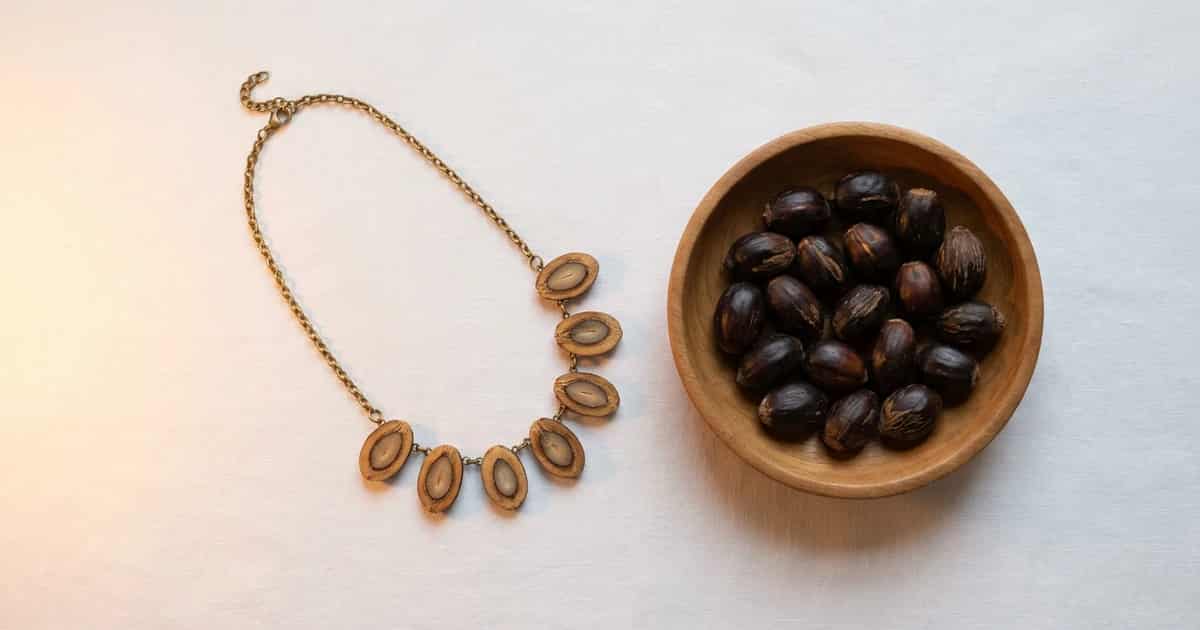
With two reading instruments: the ikin, sixteen palm nuts, and the opele, the chain with eight half seed shells (Bascom, p. 3). The figures obtained with the ikin are marked on a wooden tray; on its rim there is at least one stylized face, identified as Eshu, the messenger of Ifá (p. 34). A powder is scattered over the tray, the iyerosun, which in Ife is the dust that termites leave in a wood called irosun (p. 35).
6. Ikin or opele: which counts for more?
Both arrive at the same figures and the same verses. Bascom records that the chain "talks more" and is the more commonly used, because it is faster and answers more questions; even so, it is regarded as an inferior instrument, less reliable for important questions, and is called Ifá's servant (p. 29).
7. How does one arrive at an Odu?
With the ikin, the babalawo holds the sixteen nuts and tries to grab them with his right hand: if two are left in the left hand, he marks a single line; if one is left, he marks a double one. Four markings give one of the sixteen basic figures; eight give one of the 256 (Bascom, p. 3). With the opele, a single cast is enough: each half seed shell falls with the concave or the convex side up, and the eight together form the whole figure (p. 3).
8. How many Odus are there?
Two hundred and fifty-six. Abímbọ́lá records the division: sixteen major and 240 minor ones, the major regarded as far senior, in an order of seniority that begins with Eji Ogbe; he notes that the list is accepted by most priests, with local variations (Abímbọ́lá, Sixteen Great Poems of Ifá, p. 29). On this site, the 240 are called Omoluos. The sixteen are in the map of the 16 Odu Meji.
How the consultation works
9. Is the Odu that comes out a matter of luck?
Statistically, each figure has one chance in 256 with a good chain. For the diviners there is no chance: it is Ifá who controls the fall of the seeds, and any interference, from the instrument or from the hand, garbles the message he wants to convey (Bascom, p. 30).
10. Do I have to tell the babalawo my problem?
In Ife, the custom Bascom records is the opposite. The querent whispers the question to the coin he is about to hand over, covering his mouth, and the babalawo touches the chain to the coin and asks Ifá whether he heard (p. 68). The Ife informants said it was wrong for the diviner to know the problem, because he would be tempted to lie to please (p. 68). The Araba of Igana added that, once the verse has been chosen, the diviner may draw on what he knows of the client's life to advise him, but the client should not say why he came (p. 69).
11. How does the answer appear?
Bascom describes three steps: the figure, the verse and the sacrifice (p. 68). The babalawo recites the verses he has memorized for the Odu that came out, and the querent listens until he hears one that speaks to his case. According to Bascom, it is the querent himself who chooses the verse (p. 69). He also records the disagreement: three Yoruba authors, J. Johnson, S. Johnson and Lucas, say that it is the diviner who chooses (p. 69).
12. How many verses does a babalawo know?
Many, and never enough. Abímbọ́lá writes that each Odu has hundreds of poems associated with it (p. 30). In Ife, Bascom heard that one must know at least four verses per figure, more than a thousand in all, before working alone; in Igana two were enough; in Meko, one. The Araba of Igana said he knew about four for each figure and eighty for Eji Ogbe. And the study does not end: the diviner keeps learning until he dies (Bascom, p. 71).
13. Does Ifá tell the future?
Bascom cautions those who expect Ifá to name the winner of an election or a race: you can ask, he says, but that is not the kind of question Ifá answers. Ifá's questions are of the kind "which of these candidates is best for everyone" or "what sacrifice is needed for the best outcome" (p. 69). And he notes that, as with other systems and even with medicine, the querent is rarely able to decide whether the prediction was right (pp. 69–70).
Ẹbọ, price and trust
14. What is ẹbọ?
It is the sacrifice the verse indicates. Bascom records that the verses prescribe the sacrifice and that it may be modified (p. 68). A diviner explained the logic to him: if what was foretold is bad, the ebo is made so that it will come less severely; if it is good, so that it will come greater and sooner (p. 70). We explain the idea, without recipes, in Ebo: what offerings are.
15. Can one bargain?
Not with the querent making the offer. Bascom records the saying that one does not bargain with Ifá as in the market: the one who proposes a change in the sacrifice is the diviner, and the change goes through Ifá's approval (p. 76). The diviners admit taking the client's wealth into account, but they are expected to be reasonable; clients say that a poor person may be asked for a hair instead of a horse, or a feather instead of a chicken (p. 76).
16. Are there dishonest babalawos?
Clients and diviners believe so, and that is why the question is kept hidden (p. 76). Falsifying Ifá's message is regarded as strictly unethical (p. 77). Bascom, however, says that from his own experience most babalawos are honest and work in good faith, within a system they themselves believe in and by which they order their own lives (p. 79).
17. Can a woman be a babalawo?
In the works we use, no. Bascom records that only men become babalawo, and that women who worship Ifá may be charged with caring for their father's palm nuts (p. 81). In cowrie divination, by contrast, diviners may be men or women (Bascom, Sixteen Cowries, p. 21). On the title of women initiated into Ifá itself we have no source, and we will not fill the gap with guesswork.
Ifá and the reader
18. Does Ifá exist outside Nigeria?
Yes. Bascom records Ifá divination among the Yoruba and the Benin Edo in Nigeria, among the Fon of Dahomey, who call it Fa, among the Ewe of Togo and, under the name Ifá, among descendants of enslaved Yoruba in Cuba and Brazil (p. 3). In the Bahia that Bastide studied, the babalaô still worked with the opelê (Bastide, p. 141).
19. How do I find out which Odu is mine?
Verger records that when a child is born, the parents ask the babalawo to indicate which of the 256 Odus it is linked to (Verger, Orixás, p. 56); and Bascom, from the account of a priest he interviewed, concludes that those who are neither Muslim nor Christian take their children to an Ifá diviner to learn their destiny at birth (Bascom, Sixteen Cowries, p. 21). It is the babalawo's office, and his alone. This site does not and will not tell anyone which Odu is theirs. We explain why in Birth Odu.
20. And this site's tool, is it a consultation?
No. It uses artificial intelligence to study and contemplate the corpus of the 256 Odus; an AI has no ase and does not replace the sacred casting of Ifá. The Odu of the Day is the same for everyone and was not cast for you. Anyone who needs guidance, ẹbọ or a real consultation should go to a consecrated babalawo.
What you have read here is rooted in the 256 Odus of Ifá — the corpus we study verse by verse. Read them as contemplation: real divination belongs at the table of a consecrated babalawo.
Sources consulted
- Ifa Divination — William Bascom, pp. 3, 29–30, 34–35, 68–71, 76–77, 79, 81
- Sixteen Cowries — William Bascom, pp. 21–22
- Sixteen Great Poems of Ifá — Wándé Abímbọ́lá, pp. 29–30
- Orixás — Pierre Verger, p. 56 of the digital file
- O Candomblé da Bahia — Roger Bastide, p. 141
Written by
- Pablo de Lima (Awofakan)
- Thaiana de Lima (Ikofá)
A couple initiated in Ifá in the Cuban lineage — Regla de Ocha / Ifá.
Meet the authors →Last reviewed:
Get the wisdom in your inbox
One new article a week on Orishas, Odus and Yoruba philosophy. No spam.
Unsubscribe anytime, one click from any email.
Comments
Loading comments...
You need to sign in to comment.