How Ifá Divination Works: The Oracle of 256 Odus
When someone asks "how does Ifá divination work?", the answer is surprising: it's not magic, not luck, not fortune-telling cards. It is a ancient sacred communication system, so structured and logical that modern mathematicians have compared it to a binary system — the same principle that makes computers work.
Ifá doesn't "predict the future" in the popular sense. Ifá reveals — it opens a window into the wisdom of Orunmila, the Orisha who witnessed the destiny of every soul. If this is your first contact, it's worth reading first what Ifá is. In this article, you'll understand exactly how this process happens: the instruments, the method, the 256 Odus and the role of the Babalawo.
The Sacred Instruments
Ifá divination uses two main instruments, both derived from the oil palm (the sacred African palm tree):
The Opele (Ọ̀pẹ̀lẹ̀) — the divining chain
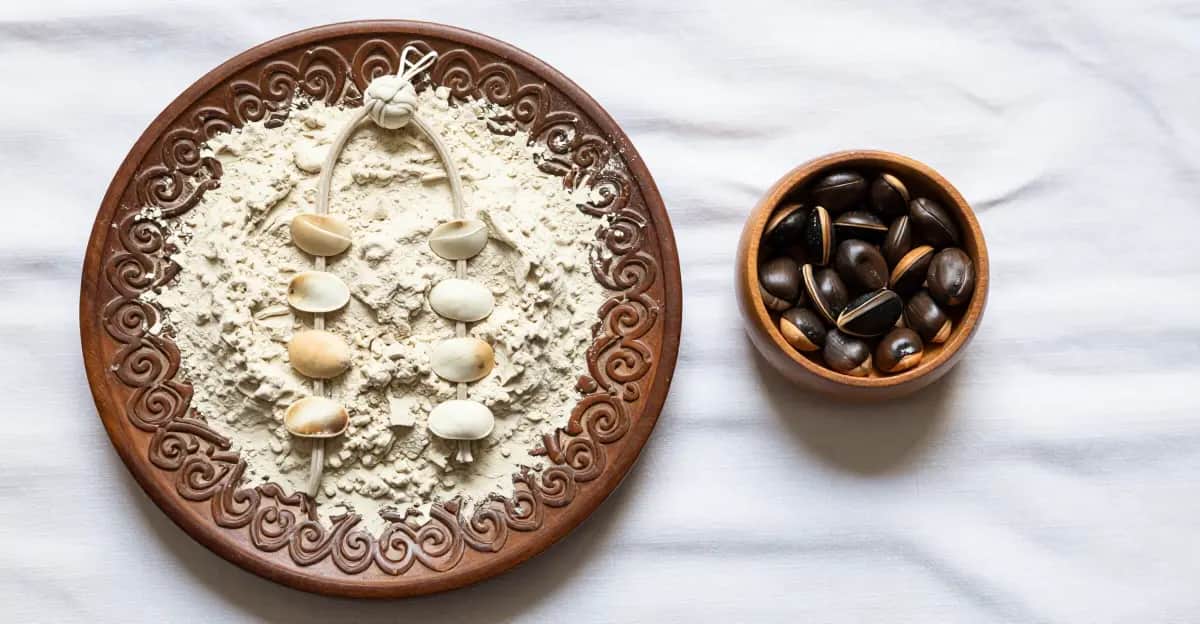
The opele is a chain with eight seed halves (or shells) fixed at regular intervals. Each half can fall with its concave ("open") or convex ("closed") face up. When the Babalawo casts the chain onto the mat, the eight pieces instantly form a pattern — two columns of four marks each.
The opele is the everyday instrument: fast, practical, used in the most frequent consultations. In seconds, it reveals which of the 256 Odus is speaking.
The Ikin (Ìkín) — the sacred seeds
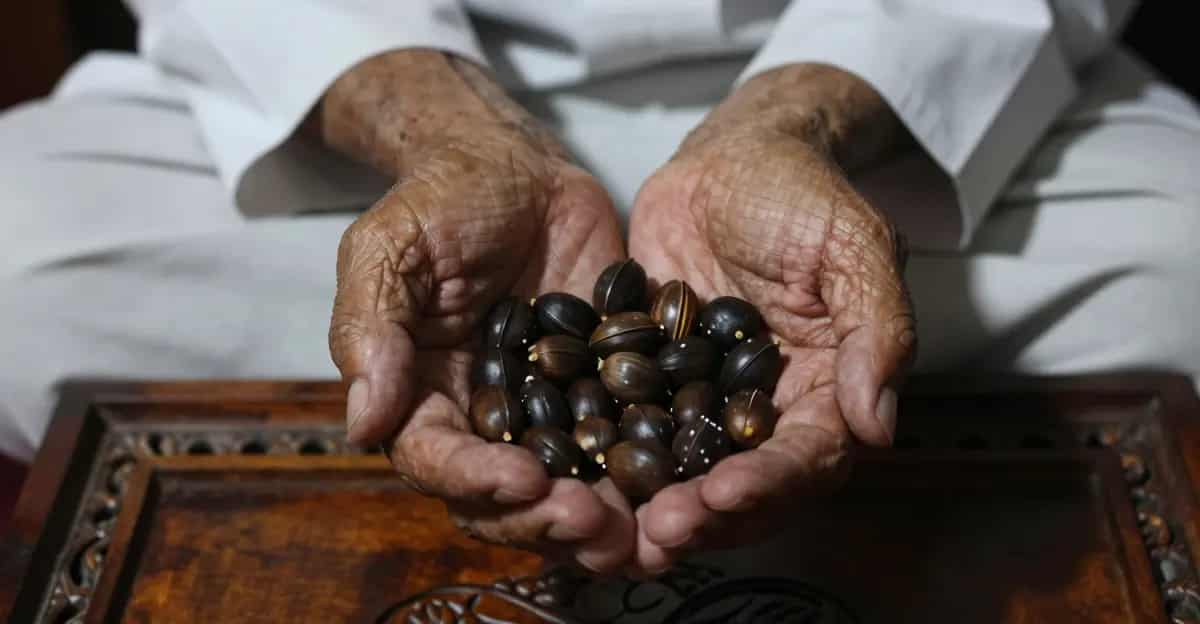
The ikin are 16 oil-palm seeds, considered the most sacred and ancient instrument. Reading with ikin is slower and more ritualistic: the Babalawo holds the 16 seeds in one hand and tries to grab them with the other. The rule is counter-intuitive, and it is what gives the casting its rhythm: if one seed stays in the original hand, a double mark is made (II); if two stay, a single mark (I); if none stay, or more than two, the cast does not count and is repeated. The marks are set down in the sacred powder (iyerosun) spread over the opon Ifá (divination tray).
Repeating the gesture eight times forms the same kind of pattern as the opele — but the process, being slower, is reserved for important consultations, initiations and solemn ceremonies.
The Opon Ifá — the Sacred Tray
The opon Ifá is a wooden tray, usually circular or rectangular, with beautiful carvings around the edges. In the center the iyerosun is spread, a pale powder made from the wood of the irosun tree. It is on this powder that the Babalawo marks the lines revealed by the ikin.
The edge of the tray almost always bears the face of Eshu carved at the top — for it is Eshu, the messenger, who carries humans' questions to Orunmila and brings back the answers. No consultation happens without Eshu being greeted first.
The Binary System of the 256 Odus
Here lies the mathematical genius of Ifá. Each cast generates a pattern of eight positions, and each position has two possibilities (single or double mark). But the system is organized on two levels:
- Each half of the pattern (four marks) forms one of the 16 main Odus (Olódù)
- The combination of the two halves (16 × 16) generates the complete 256 Odus (Odù)
Sixteen times sixteen equals 256. It is a base-2 system of two base-16 digits — a combinatorial structure that ethnomathematician Ron Eglash and other scholars have compared directly to the binary logic of computers. The Yoruba developed this long before, long before Leibniz formalized the binary system in the West.
Each of the 256 Odus is a universe of meaning: it contains stories (itan), verses (Ese Ifá), prescriptions, prohibitions and the Orishas associated with that pattern.
The Ese Ifá — the Sacred Verses
Once the Odu is identified, the Babalawo's work is only beginning. Each Odu carries hundreds of memorized verses — the Ese Ifá. These are poems, parables and narratives that describe archetypal situations of human life.
A typical Ese Ifá follows a structure:
- It tells a story from the past — someone who faced a similar situation
- It says what that person did (or failed to do)
- It reveals the outcome — success or failure
- It draws out the lesson and the prescription for the one consulting
The Babalawo doesn't choose the verse at random: he chooses the one that resonates with the question and the situation of the person consulting. This is where decades of study come in — an experienced Babalawo memorizes thousands of verses and knows, through trained intuition, which one speaks to that moment.
How the Babalawo Reads and Interprets
The complete process of a traditional consultation:
- Greeting Eshu — the messenger is honored to open the paths of communication
- The question — the one consulting speaks (or thinks) their question. It may be about health, work, relationships, decisions
- The cast — the Babalawo throws the opele or manipulates the ikin
- Identifying the Odu — the pattern reveals which of the 256 Odus answered
- Determining ìre or ibi — the Babalawo checks whether the sign arrives with blessing (ìre) or with obstacle and warning (ibi, which the Cuban tradition and Candomblé call osogbo), through complementary casts
- Reciting the Ese Ifá — the relevant verses are recited
- Interpretation — the Babalawo translates the Odu's wisdom to the concrete situation
- Ẹbọ (prescription) — a recommendation of what to do: offerings, changes in behavior, precautions
In-Person vs. Contemplative Consultation
There is an important difference to understand with respect:
In-person consultation with a Babalawo — this is the traditional, complete and irreplaceable form. It involves an initiated priest, years of training, the full ritual, the reading of ìre/ibi and the prescription of ẹbọ. It is a relationship, not a one-time event.
Digital contemplative study — platforms like Ifá Wisdom offer a moment of guided reflection by the same principles: the Odu drawn for study, the wisdom of the verses, the connection with the tradition. Nothing there is revealed: the sign was not cast for you. It does not replace the Babalawo, just as reading a philosophy book does not replace a master — but it opens doors, awakens curiosity and offers a moment of pause and introspection. If you'd like to start gently, our beginner's guide to Ifá shows the first steps.
Honesty here is essential: a digital consultation is an invitation to reflection and to a first contact with the tradition, not a priestly ceremony. Both have their value, as long as each is understood for what it is.
Ifá Doesn't Predict — Ifá Guides
The biggest misunderstanding about Ifá divination is thinking it "tells the future" in a fixed way. It's not like that. Ifá works with the concept of negotiable destiny: you are born with a path (Orí), but your choices, your character (Ìwà) and your actions shape how that path unfolds.
The consultation reveals tendencies, energies and warnings — and offers guidance on how to act. The future is not set in stone: it is under construction, and Ifá is the map that helps you navigate it with wisdom.
"Ifá does not decide for you. Ifá illuminates the path so that you may decide better. The oracle points the direction; the feet that walk are always your own."
Ifá divination is, at its core, one of humanity's oldest and most sophisticated technologies of self-knowledge. It doesn't promise miracles — it promises clarity. And clarity, in any age, is one of the rarest and most valuable things there is.
What you have read here is rooted in the 256 Odus of Ifá — the corpus we study verse by verse. Read them as contemplation: real divination belongs at the table of a consecrated babalawo.
Sources consulted
- Ifa Divination — William Bascom, pp. 26–50
Written by
- Pablo de Lima (Awofakan)
- Thaiana de Lima (Ikofá)
A couple initiated in Ifá in the Cuban lineage — Regla de Ocha / Ifá.
Meet the authors →Last reviewed:
Get the wisdom in your inbox
One new article a week on Orishas, Odus and Yoruba philosophy. No spam.
Unsubscribe anytime, one click from any email.
Comments
Loading comments...
You need to sign in to comment.